
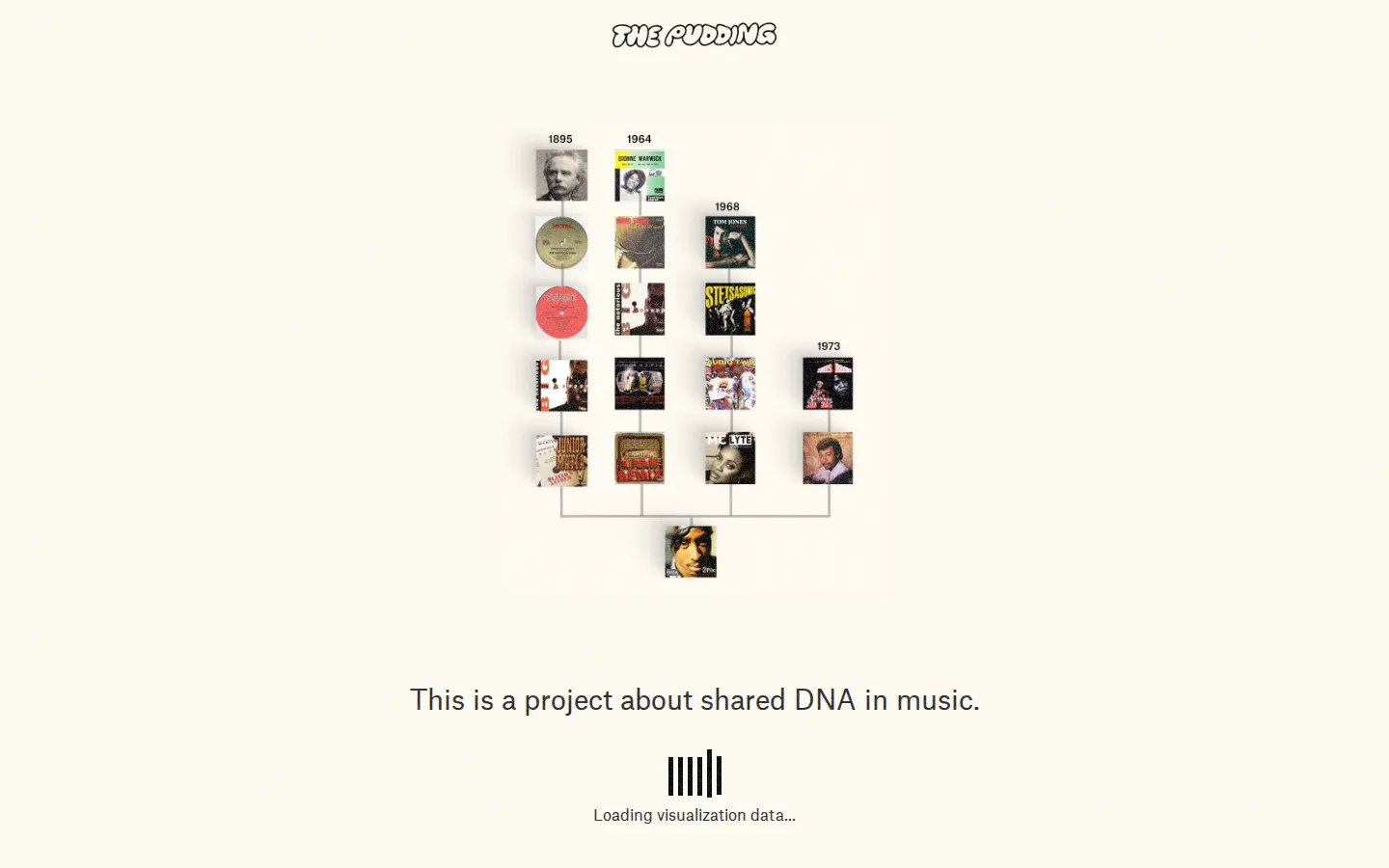
Music DNA turns sampling and interpolation into a guided visual essay, following musical family trees from old melodies and drum breaks into modern pop and hip-hop. Its finest trick is scale: a focused chain blooms into hundreds of connected songs, while the methodology keeps those links framed as interpretation rather than settled genealogy.
What is Music DNA?
The story begins with a few recognizable hand-me-downs, then keeps pulling on the thread. A classical melody reaches a cartoon theme and later rap records; drum breaks branch into second-generation hits; phrases and riddims migrate into songs that may sound worlds apart. The presentation groups those routes as borrowed beats, loaned lyrics, and multipurpose melodies, giving a sprawling subject a clean listening map. One featured lineage gathers 82 songs around Tupac's Hit 'Em Up, while another view traces five generations and 833 descendants from In the Hall of the Mountain King. That widening scale is the point: musical ancestry behaves less like a neat chain than a very busy family reunion.
What you can do there
- Follow song-to-song musical lineages
- Compare borrowed beats, lyrics, and melodies
Why we picked it
The piece makes a complicated network legible without sanding away its uncertainty. Each branch supplies a concrete way to hear history moving, and the expanding diagrams turn familiar records into surprising relatives. Just as importantly, the methodology admits that undocumented borrowing and interpretive judgment keep the map from being final.
How to get the most from it
Follow the opening lineage before trying to absorb the largest network. Then revisit the borrowed-beat, lyric, and melody sections separately; keeping those three kinds of inheritance distinct makes the denser family trees much easier to read. Sound is part of the presentation, so headphones are a useful companion.
Good to know
The page includes screen-reader instructions for moving between slides and written descriptions of its graphics. Its relationships draw on Genius data cross-checked with several outside sources, but they are not an exhaustive rights ledger: some musical borrowing is disputed, informal, or never formally credited. The experience is free to read, while live audio and device behavior were not verified here.
Who made it, and when?
Stephen Lurie (story) and Jared Whalen (graphics) is the credited creator or organization. The earliest supported launch date we found is April 1, 2025.
Open Music DNAMore like this
Radio Garden

Spin the globe and tune into live radio stations almost anywhere on Earth.
Chrome Music Lab

Friendly musical experiments that explain rhythm, melody, sound waves, and harmony by letting you play.
Blob Opera

Conduct four cheerful blobs whose vowel-shaped voices turn almost any gesture into opera.
Patatap

Turn every letter key into a synchronized burst of sound and animation.