
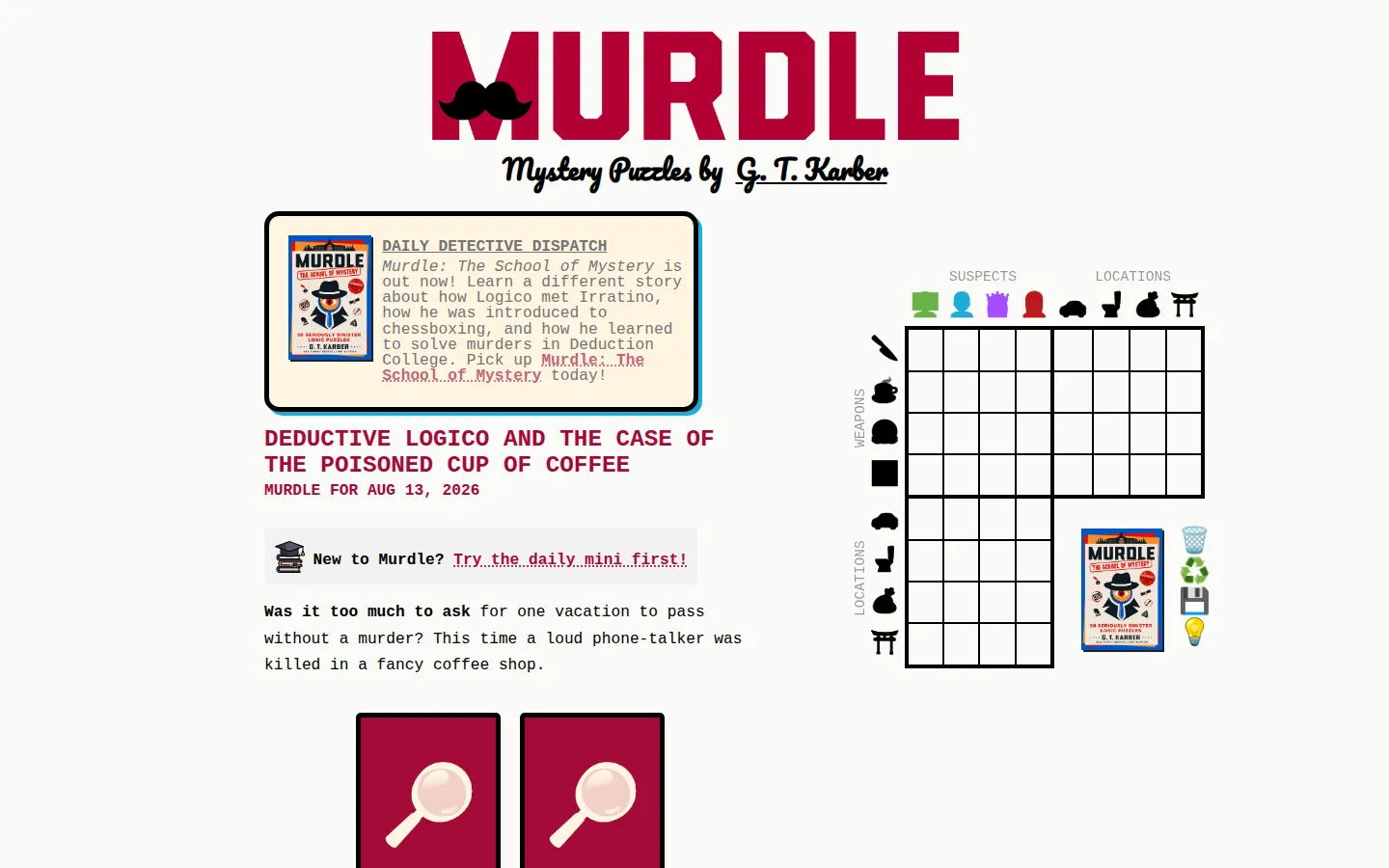
Murdle delivers a new logic-grid murder mystery each day, turning suspects, weapons, locations, and clues into a compact case for your inner detective to untangle.
What is Murdle?
Murdle is murder mystery reduced to its most satisfying machinery: a few possible culprits, a few possible tools of mayhem, a few places where things went sideways, and enough clues to make the grid click into place. The result is less about lurid crime than the pleasant sting of deduction. Its homepage promises a fresh mystery every day, while independent reporting describes the format as a Sudoku-and-Cluedo-like puzzle with a tick-box grid and recurring detective characters. Creator G. T. Karber’s official site identifies him as the mind behind the series, which later grew into books based on the online puzzles. Give the clues a slow first read, mark only what the logic genuinely earns, and let contradictions do their useful little job. When the final square fills in, the satisfaction is not that you guessed a villain; it is that you built the case yourself.
What you can do there
- Read murder-mystery clues
- Use deduction to identify the culprit
Why we picked it
Murdle makes detective fiction playable without drowning the player in rules. A familiar grid carries the reasoning, leaving the clues and the tiny theater of the mystery to provide the flavor.
How to get the most from it
Read all of the clues once before committing to the grid. Mark direct matches and exclusions, then return to any clue that becomes clearer after another category is fixed. Use hints sparingly if you want the final accusation to feel fully earned.
Good to know
The daily format is built around logic-grid deduction, so the same basic structure returns even as the cases change. This profile did not verify current accessibility, mobile usability, or the technical process that creates the daily puzzle, and no screenshot was captured.
Who made it, and when?
G. T. Karber is the credited creator or organization.
Open MurdleMore like this
The Library of Babel

Search an imaginary library that contains every possible page of a fixed length—including this sentence somewhere.
FutureMe

Write an email to yourself and choose a date far enough away to make it meaningful.
Wowfold

A paper-plane hangar stocked with darts, gliders, and expert oddballs
Arcane Intern

A magical publishing internship where coffee runs come with sigils.