
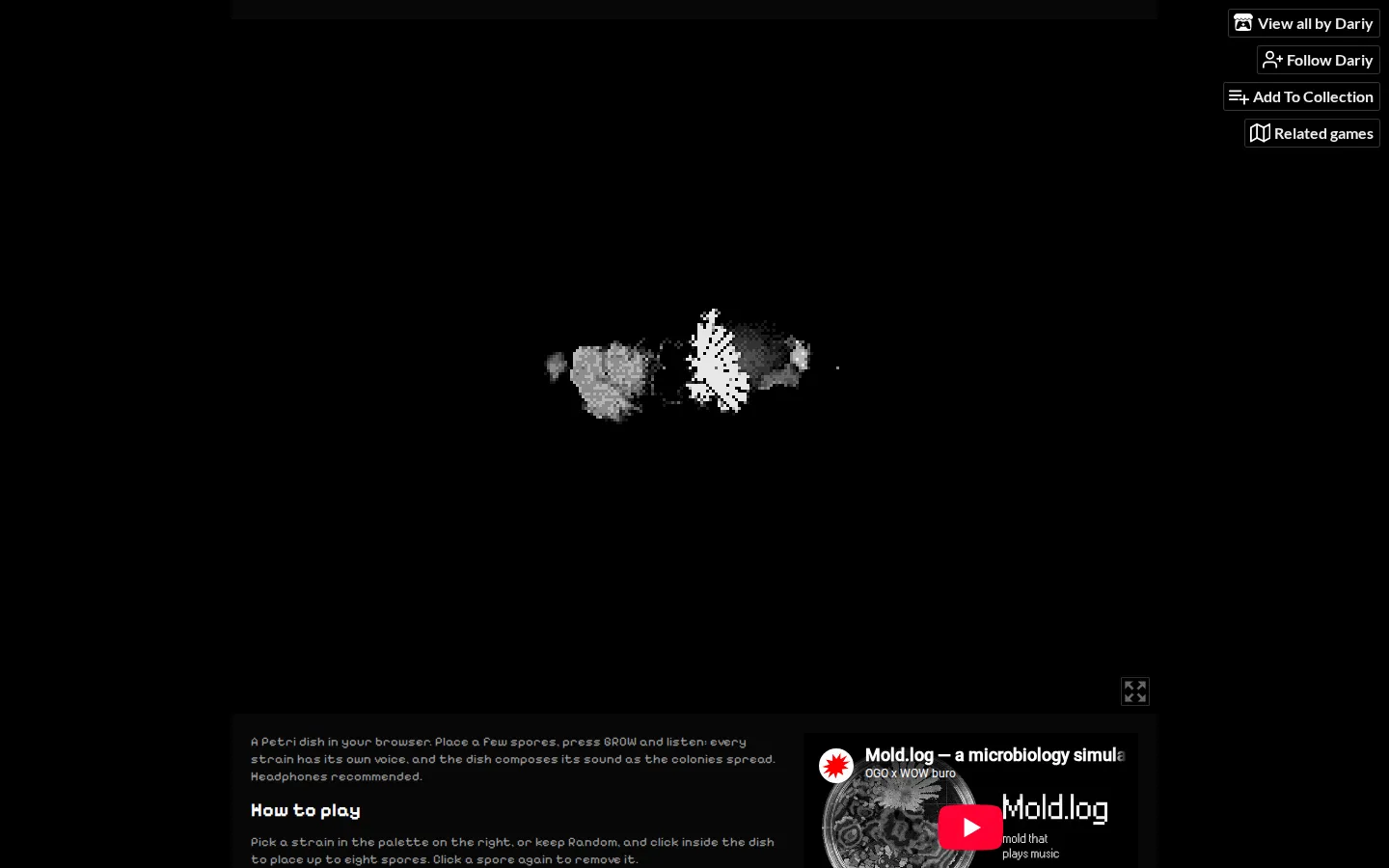
Mold.log turns a Petri dish into a compact generative instrument. Plant a handful of virtual spores, start the culture, and watch competing colonies shape both the picture and an evolving synthesized score.
What is Mold.log?
The setup is wonderfully legible: choose one of twelve microbe-inspired strains or leave the palette on Random, dot up to eight spores around the dish, then press GROW. Colonies expand, crowd one another, leave dark seams at their borders, and occasionally send out daughter colonies. Their motion also drives an all-synthesized soundtrack, so the dish behaves less like a biology lesson and more like a tiny, unruly sequencer. Pause when a pattern catches your eye, export it as a PNG, or hit BURN and cultivate a new composition.
What you can do there
- Place virtual spores
- Grow and pause colonies
- Listen to synthesized colony voices
- Save the dish as a PNG
- Burn the dish and restart
Why we picked it
It binds image-making and sound-making to the same simple rule set. A few clicks produce a result with enough variation to invite another dish, while the clinical black-and-white interface keeps the microbial chaos readable.
How to get the most from it
Start with Random and scatter spores far apart to hear and see the strains develop. For a more deliberate composition, choose individual strains, pause to inspect a promising collision, and save the dish before burning it clean.
Good to know
Sound is central and headphones are recommended, though a mute control is documented. The page also offers an offline 1.8 MB download. The simulation was not run during this review, so mobile behavior, accessibility, autoplay rules, and performance remain unconfirmed.
Who made it, and when?
Darius Nazarov is the credited creator or organization. The earliest supported launch date we found is October 9, 2026. A documented update was recorded October 9, 2026.
Creator’s official page Open Mold.logMore like this
Radio Garden

Spin the globe and tune into live radio stations almost anywhere on Earth.
Chrome Music Lab

Friendly musical experiments that explain rhythm, melody, sound waves, and harmony by letting you play.
Blob Opera

Conduct four cheerful blobs whose vowel-shaped voices turn almost any gesture into opera.
Patatap

Turn every letter key into a synchronized burst of sound and animation.