
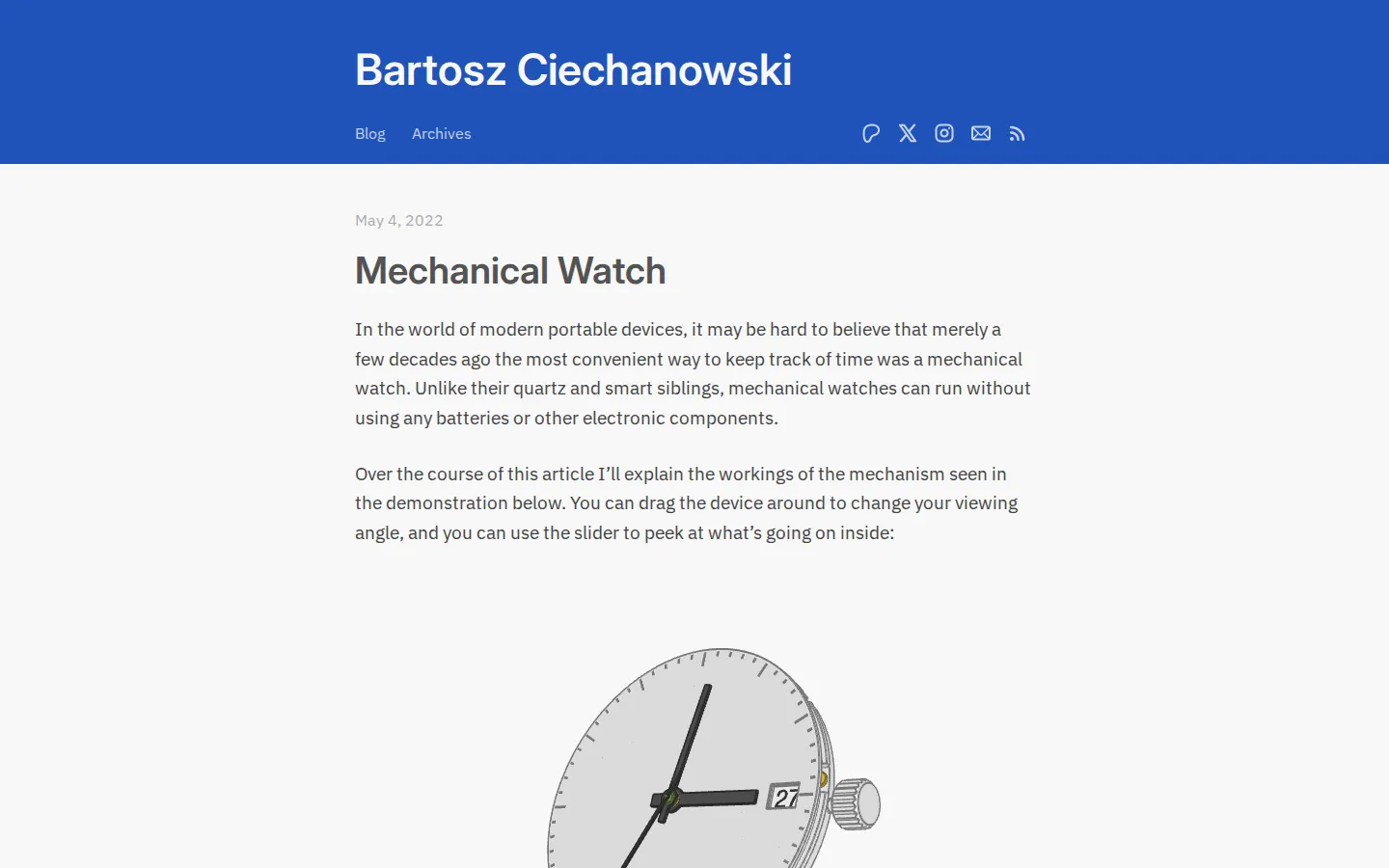
Mechanical Watch is Bartosz Ciechanowski's lavish, part-by-part explanation of a machine most wrists keep hidden. It follows stored energy from the mainspring into the gear train, escapement, and balance, then mounts the pieces onto a mainplate and adds the controls that wind the watch and move its hands. The page turns a thicket of tiny parts into a sequence with a pulse.
What is Mechanical Watch?
The tour begins with a spring trying to unwind and refuses to skip the awkward engineering between that urge and a steady second hand. Gears multiply rotation, the escapement portions out energy, and the balance supplies a repeatable rhythm; after those relationships make sense, the article assembles the mechanism around them. The described models can be rotated, slowed, scrubbed, wound, and globally paused, while color-coded parts keep names attached to shapes. Later sections extend the same logic into winding, setting the hands, and changing the date.
What you can do there
- Follow a watch movement from mainspring to hands
- Manipulate the article's described mechanical models
Why we picked it
A mechanical watch is a perfect candidate for an explorable explanation: everything matters, almost everything moves, and the important pieces usually disappear beneath bridges and a dial. This page solves that visibility problem with unusually generous diagrams and a careful build order. Watch-focused independent coverage has praised both its component-by-component completeness and the sheer number of interactive illustrations, but the real achievement is making the assembly feel understandable rather than merely impressive.
How to get the most from it
Start with the mainspring and resist jumping straight to the complete movement. Pause or slow each mechanism, identify the color-coded parts, and trace where energy enters and where motion is allowed to escape. Once the balance section clicks, revisit the gear train; the relationship between fast oscillation and slow hands is much easier to see on the second pass.
Good to know
The English-language article was published on May 4, 2022, and its reading layer is openly accessible. It explains principles and assembly rather than offering repair procedures or advice for a particular watch. Live models, device support, performance, accessibility, motion preferences, sound, and runtime privacy behavior have not been independently verified.
Who made it, and when?
Bartosz Ciechanowski is the credited creator or organization. The earliest supported launch date we found is May 4, 2022.
Creator’s official page Open Mechanical WatchMore like this
Neal.fun

A cabinet of interactive ideas that makes learning feel suspiciously like play.
Quick, Draw!

Doodle against the clock while a neural network tries to guess your subject.
Sandspiel

Paint with sand, water, fire, plants, oil, and other tiny materials that react to one another.
WebGL Fluid Simulation

Push luminous liquid color around the screen and watch digital turbulence behave beautifully.