
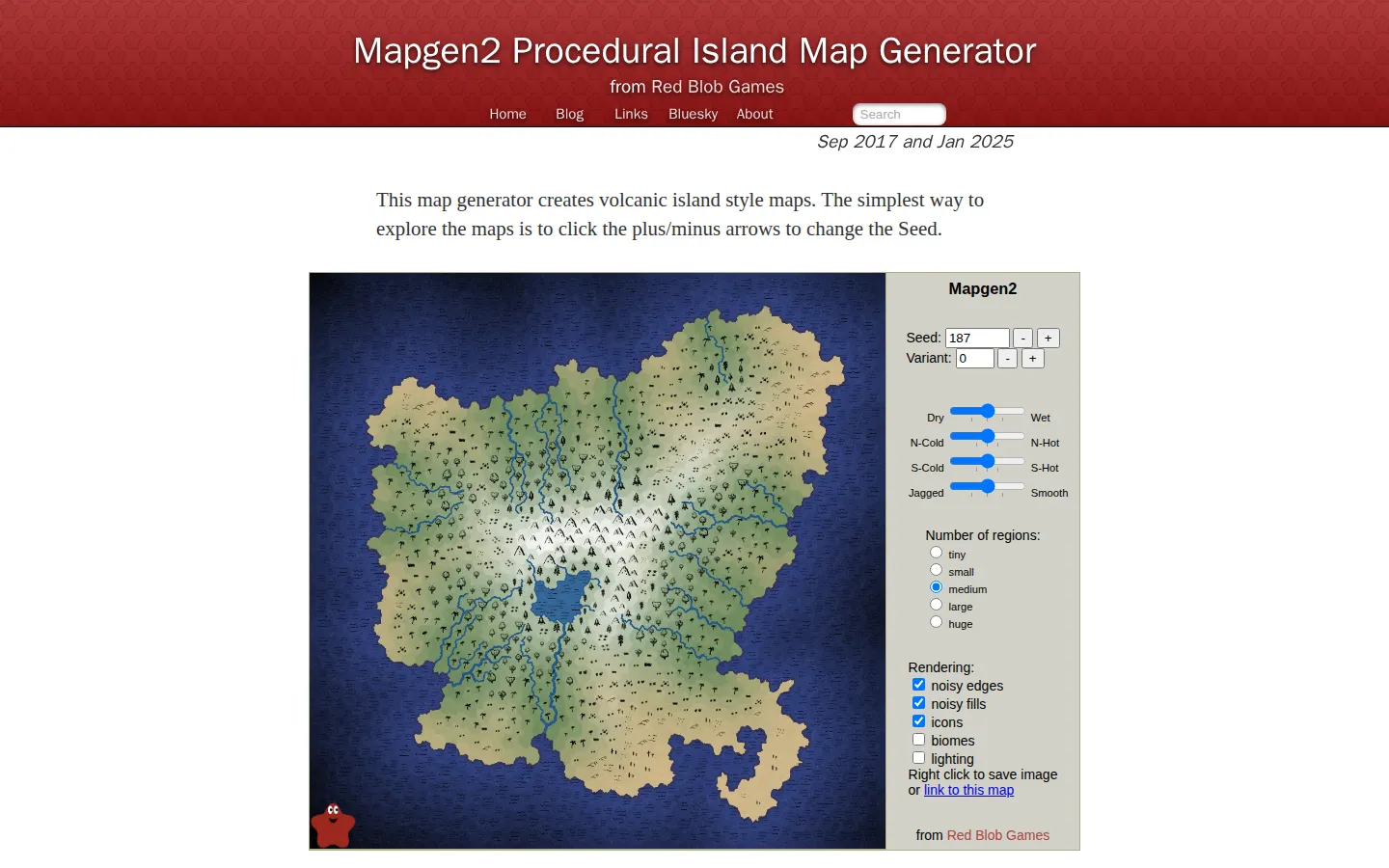
Mapgen2 is a compact procedural island workshop from Red Blob Games. Change a seed for a fresh landmass, then tune moisture, temperature, coast roughness, region count, biomes, icons, and lighting before saving an image or sharing the parameters.
What is Mapgen2?
The generator puts nearly all of its knobs beside the map, so the experiment reads like a tiny control desk. Seed and variant numbers swap the underlying island; climate sliders push it from dry to wet and cold to hot; another control negotiates between jagged and smooth. Region size and rendering switches change how much detail reaches the final drawing. The output is deliberately shaped for a game rather than for geographic realism, which is part of its charm: mountains favor the center, coastlines want interesting silhouettes, and biomes follow a simplified model. Source notes and an open repository make the toy useful as both a distraction and a trailhead into procedural-map design.
What you can do there
- Change the seed to generate another island
- Adjust climate, shape, size, and rendering controls
- Save an image or share a parameterized map link
Why we picked it
Mapgen2 makes algorithmic terrain legible without sanding off the surprise. A single seed can send you hunting for an unlikely ice lake, while the visible climate and rendering controls reveal just enough of the machinery to encourage experiments. It is a map generator that also quietly teaches why a game map and a plausible planet are different design problems.
How to get the most from it
Begin by stepping through seeds until an island silhouette catches your eye. Then change one family of controls at a time: moisture and temperature first, shape and region count next, rendering details last. Save or share only after the combination settles, because the link is intended to preserve the current parameters.
Good to know
The terrain is intentionally unrealistic and optimized for a particular game-shaped problem. The live canvas, keyboard controls, image export, share-link persistence, mobile layout, performance, and accessibility were not tested in a rendered session. The project publishes source code, but deployed-source parity was not audited.
Who made it, and when?
Amit Patel is the credited creator or organization. The earliest supported launch date we found is September 1, 2017. A documented update was recorded April 28, 2026.
Creator’s official page Open Mapgen2More like this
The Pudding

Visual essays that use code, data, and interaction to explain culture unusually well.
Earth Nullschool

A living globe of wind, weather, ocean currents, and atmospheric motion.
The True Size Of…

Drag countries around the map and watch familiar size comparisons fall apart.
MapCrunch

Drop into a random street-level view somewhere in the world and figure out where you landed.