
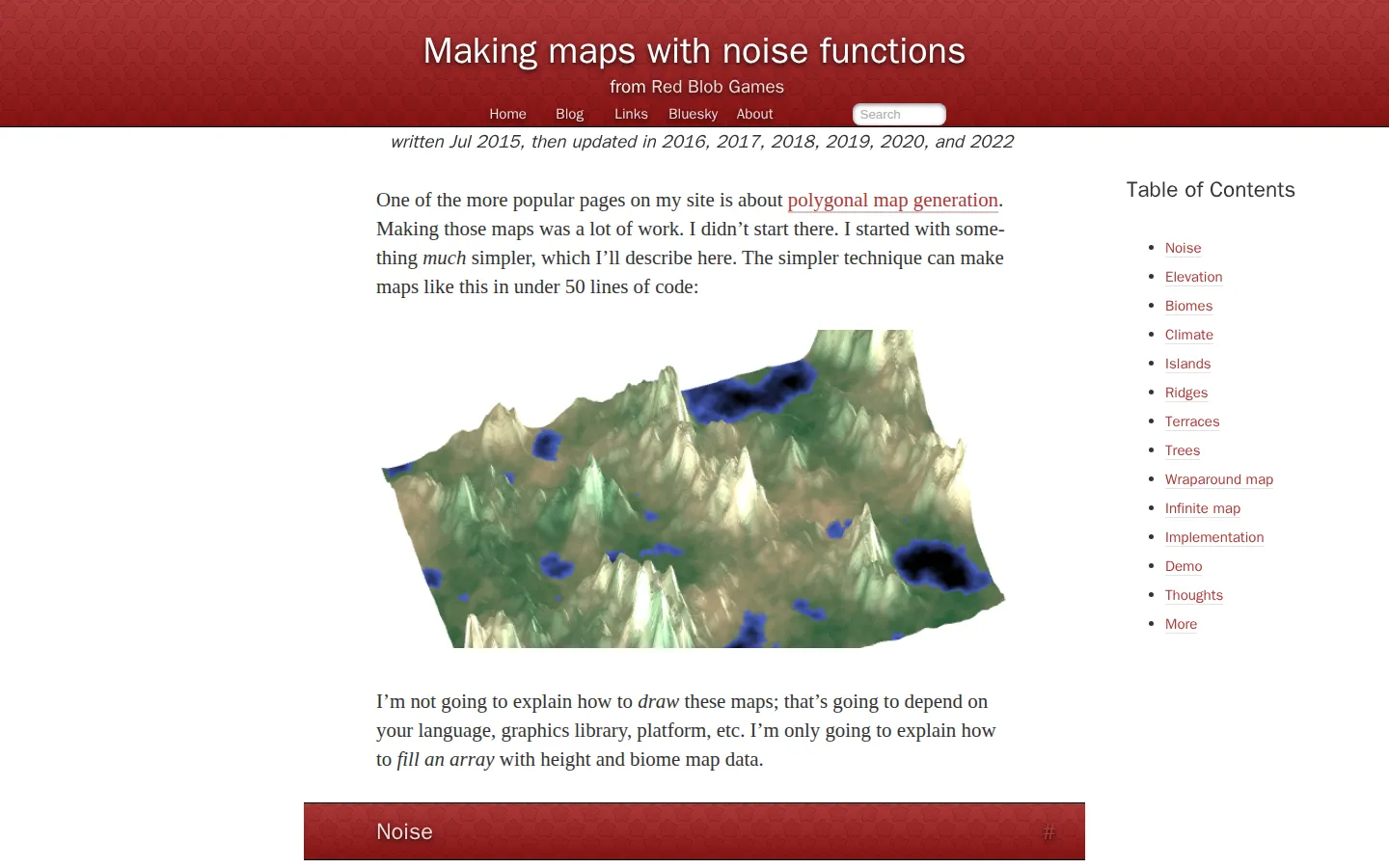
Noise becomes coastlines, peaks, forests, and climate zones in Amit Patel's unusually tactile programming lesson. The page pairs a careful progression of ideas with adjustable diagrams and practical code, then explains where the simple technique starts to crack.
What is Making Maps with Noise Functions?
This is a tutorial with dirt under its fingernails. It begins with a grid of noise values, calls them elevation, and keeps adding just enough structure to make a wilderness map emerge: octaves for scale, curves for valleys, thresholds for water, moisture for biomes, latitude for climate, and shaping functions for islands. Inputs and generated diagrams sit beside the explanations, while implementation sections translate the core loop into JavaScript, C++, and Python. Just as usefully, Patel does not sell noise as magic. He points out its endless parameter tuning, its weak sense of large-scale geography, and the moment a game may need a custom generator instead.
What you can do there
- Adjust terrain-generation parameters
- Study code examples
- Build elevation and biome maps from noise
Why we picked it
The page makes an abstract signal-processing idea feel like clay. Each section changes one ingredient, shows the consequence, and leaves the underlying math visible, which is why university computing courses have used it as both assigned reading and an example of effective technical explanation.
How to get the most from it
Read from the top and change one exposed parameter at a time before moving on. Pay particular attention to octaves, redistribution, elevation-plus-moisture biomes, and island shaping; together they form the most reusable mental model. Finish with the playground and implementation sections, then treat the code as a starting skeleton rather than a finished world generator.
Good to know
The creator says the articles are free, require no signup, and carry no ads. The tutorial itself warns that noise maps need tuning and do not naturally create global features such as connected rivers or a controlled number of lakes. Interactive controls, responsive behavior, accessibility, and current browser performance were not executed in this review, and no screenshot was captured.
Who made it, and when?
Amit Patel is the credited creator or organization. The earliest supported launch date we found is July 2015. A documented update was recorded 2022.
Creator’s official page Open Making Maps with Noise FunctionsMore like this
The Pudding

Visual essays that use code, data, and interaction to explain culture unusually well.
Earth Nullschool

A living globe of wind, weather, ocean currents, and atmospheric motion.
The True Size Of…

Drag countries around the map and watch familiar size comparisons fall apart.
MapCrunch

Drop into a random street-level view somewhere in the world and figure out where you landed.