
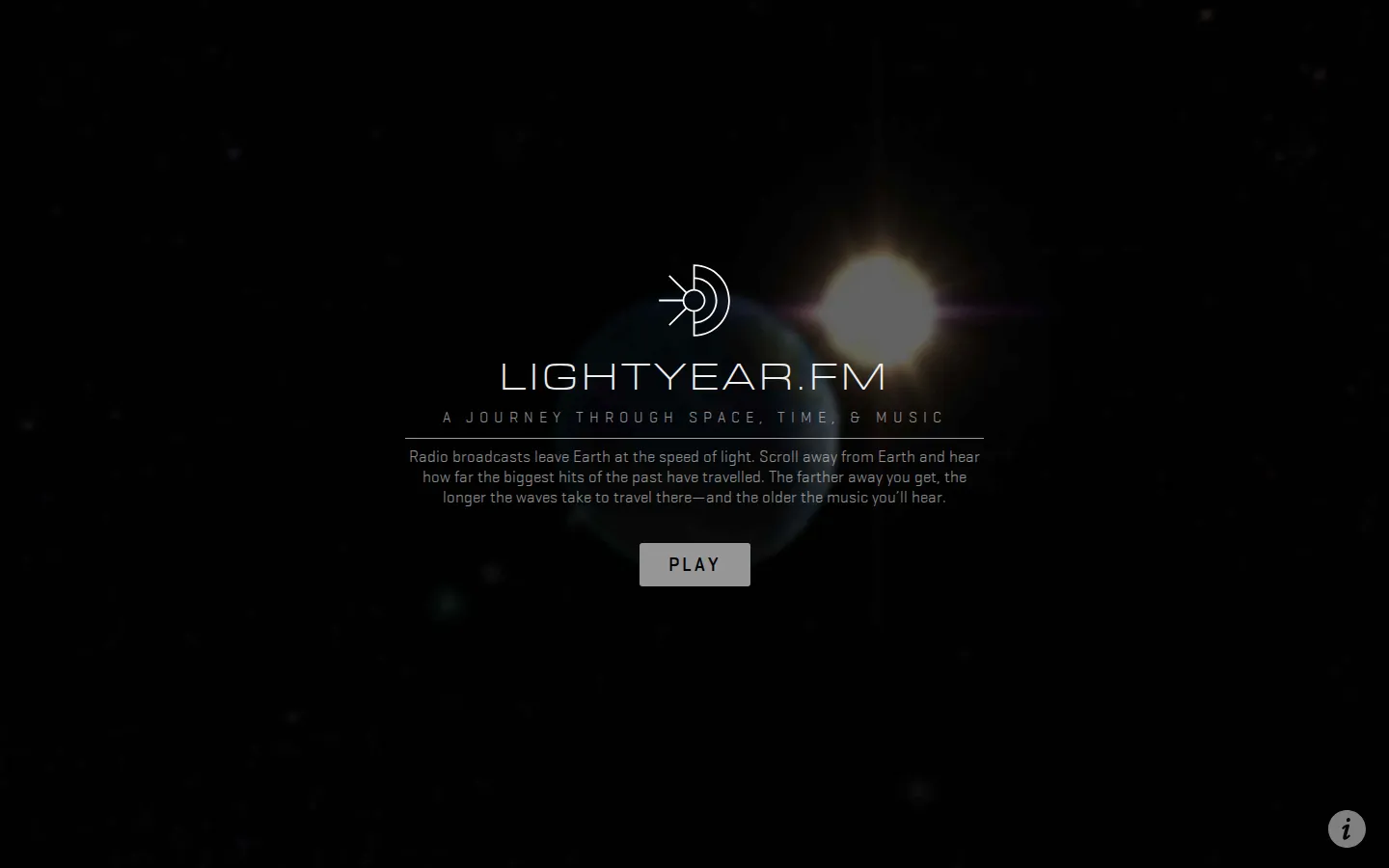
Lightyear.fm turns the distance between Earth and the stars into a musical time machine. As you move farther from the planet, the thought experiment rewinds the broadcasts you would encounter: more distance means older radio, until the familiar present has slipped back into an earlier soundtrack.
What is Lightyear.fm?
Lightyear.fm begins with a wonderfully cinematic question: if Earth’s radio had been travelling outward all this time, what era of our broadcasts would be arriving somewhere else in the galaxy? The site answers with a browser-based journey that links distance, light-travel time, and music. Its own description invites visitors to follow broadcasts through the Milky Way while moving backwards through time. The trick is simple enough to explain and rich enough to linger on. Move farther from Earth and the simulated radio becomes older, because a signal has had longer to make the trip. WIRED's walkthrough described a mouse-wheel flight through space and a timeline that lets visitors scrub across those changing distances. The project’s team turns an enormous physical scale into something intimate: a shift in a song, a date, and the feeling that home is now a long way behind. Mike Lacher's project notes describe a WebGL, Three.js, and Web Audio API build inspired by Contact. That film-sized ambition is visible in the concept, but Lightyear.fm stays approachable because it never asks for equations before the wonder kicks in. It lets you feel the delay first, then realize that the delay is the point.
What you can do there
- Move outward from Earth
- Connect distance with earlier radio eras
- Listen to a time-shifted music simulation
Why we picked it
Lightyear.fm is a rare web piece that makes scale tangible without turning into a lecture. It connects space, time, radio, and pop history with one intuitive gesture, letting a simple scroll do the explanatory work that a page of numbers often cannot.
How to get the most from it
Start near Earth, then move outward slowly and notice the relationship between distance and the era suggested by the audio. Try pausing at a few different scales instead of racing to the edge; the experience works best when each change has time to register as both a date and a place.
Good to know
This is an artistic radio-travel thought experiment, not a literal listening service for distant space. Independent coverage notes that real terrestrial broadcasts would fade into background noise after only a few light-years because signal strength drops with distance. The current visualization and audio were not executed in this profile pass.
Who made it, and when?
Mike Lacher is the credited creator or organization.
Creator’s official page Open Lightyear.fmMore like this
The Library of Babel

Search an imaginary library that contains every possible page of a fixed length—including this sentence somewhere.
FutureMe

Write an email to yourself and choose a date far enough away to make it meaningful.
Wowfold

A paper-plane hangar stocked with darts, gliders, and expert oddballs
Arcane Intern

A magical publishing internship where coffee runs come with sigils.