
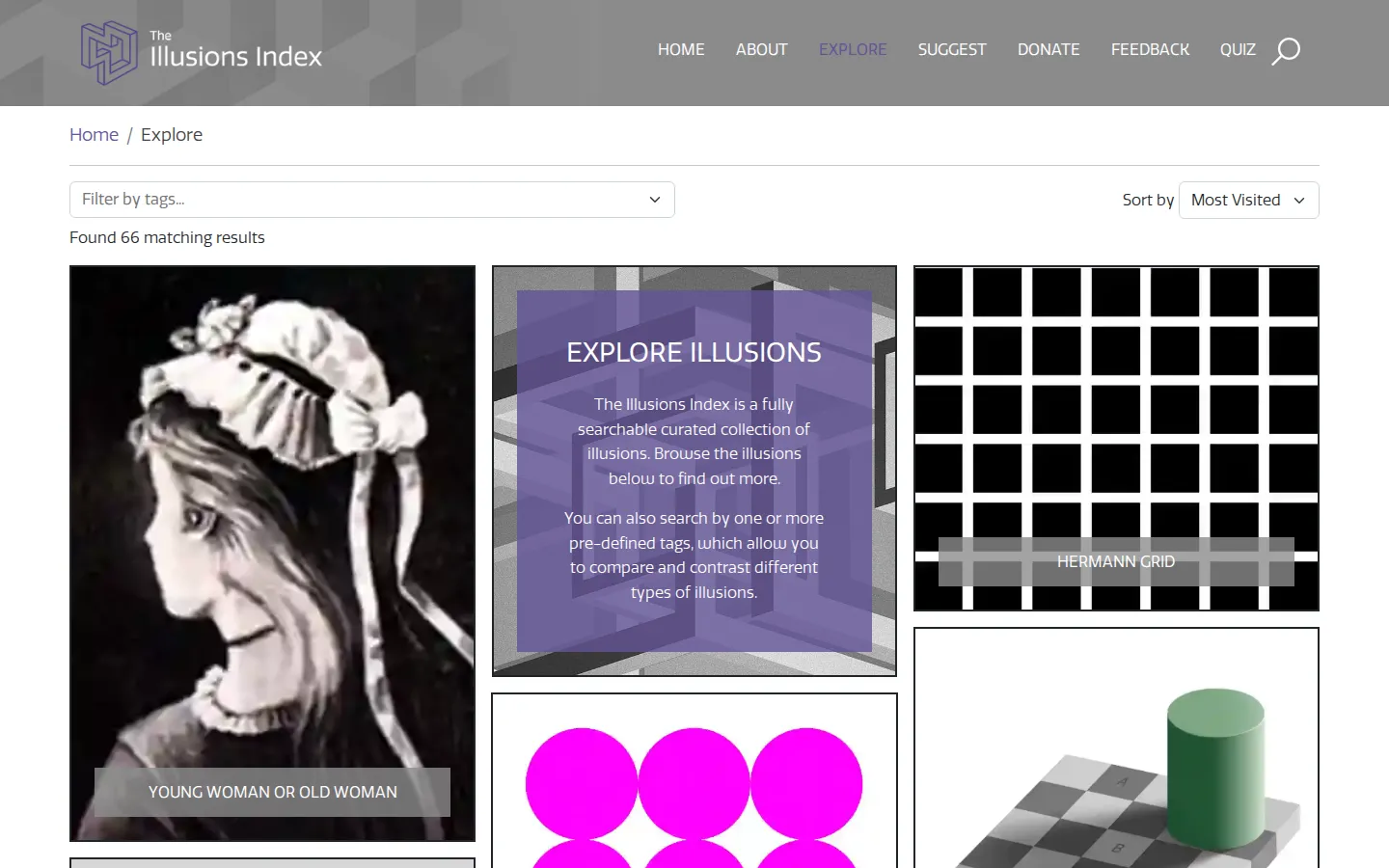
The Illusions Index pairs perceptual oddities with the instructions, history, science, and philosophy needed to understand them. Its current browse page exposes 66 entries, ranging from familiar optical traps to auditory, tactile, and cross-modal effects, with search and tag-based comparison built around the collection.
What is Illusions Index?
This is less a gallery of gotchas than a reference library with a mischievous streak. Open an entry and the trick sits beside practical instructions, a description of the expected effect, creator or discovery history, and a deeper account of what the illusion might reveal about perception. The Coffer entry, for example, moves from a squares-versus-circles switch into questions about how much conscious knowledge can influence early visual processing. References and a ready-made citation keep the rabbit hole connected to actual scholarship. The result works at two speeds: skim a row of brain-benders, or stop and unpack why seeing can remain stubbornly wrong after knowing the answer.
What you can do there
- Browse, search, sort, and filter illusion entries
- Follow an entry's instructions and compare the reported effect
- Read scientific, historical, and philosophical context
Why we picked it
Few illusion collections make the explanation as rewarding as the reveal. The mix of visual, auditory, tactile, and cross-modal material gives the catalog real range, while the University of Glasgow provenance, article credits, licensing notes, and bibliographies make it useful beyond a quick novelty break. Independent teaching and science sources also treat it as a serious reference, not just a pile of optical pranks.
How to get the most from it
Start with a familiar entry such as the Coffer Illusion, follow its viewing instructions, and notice whether the reported switch actually arrives. Then use the tags to compare related effects across shape, motion, sound, or sensory modality. Save the long commentary for after the first attempt; reading the mechanism beforehand can turn a small perceptual ambush into homework.
Good to know
The collection is open access and supported by University units and donations. Article text carries a Creative Commons BY-NC-SA licence, but individual media can have different terms, so check each entry before reuse. Some examples depend on animation, sound, or careful viewing, and the live filters, quiz, media behavior, accessibility, advertising, consent, and mobile experience were not tested in this review.
Who made it, and when?
Fiona Macpherson is the credited creator or organization. The earliest supported launch date we found is September 19, 2017.
Creator’s official page Open Illusions IndexMore like this
The Library of Babel

Search an imaginary library that contains every possible page of a fixed length—including this sentence somewhere.
FutureMe

Write an email to yourself and choose a date far enough away to make it meaningful.
Wowfold

A paper-plane hangar stocked with darts, gliders, and expert oddballs
Arcane Intern

A magical publishing internship where coffee runs come with sigils.