
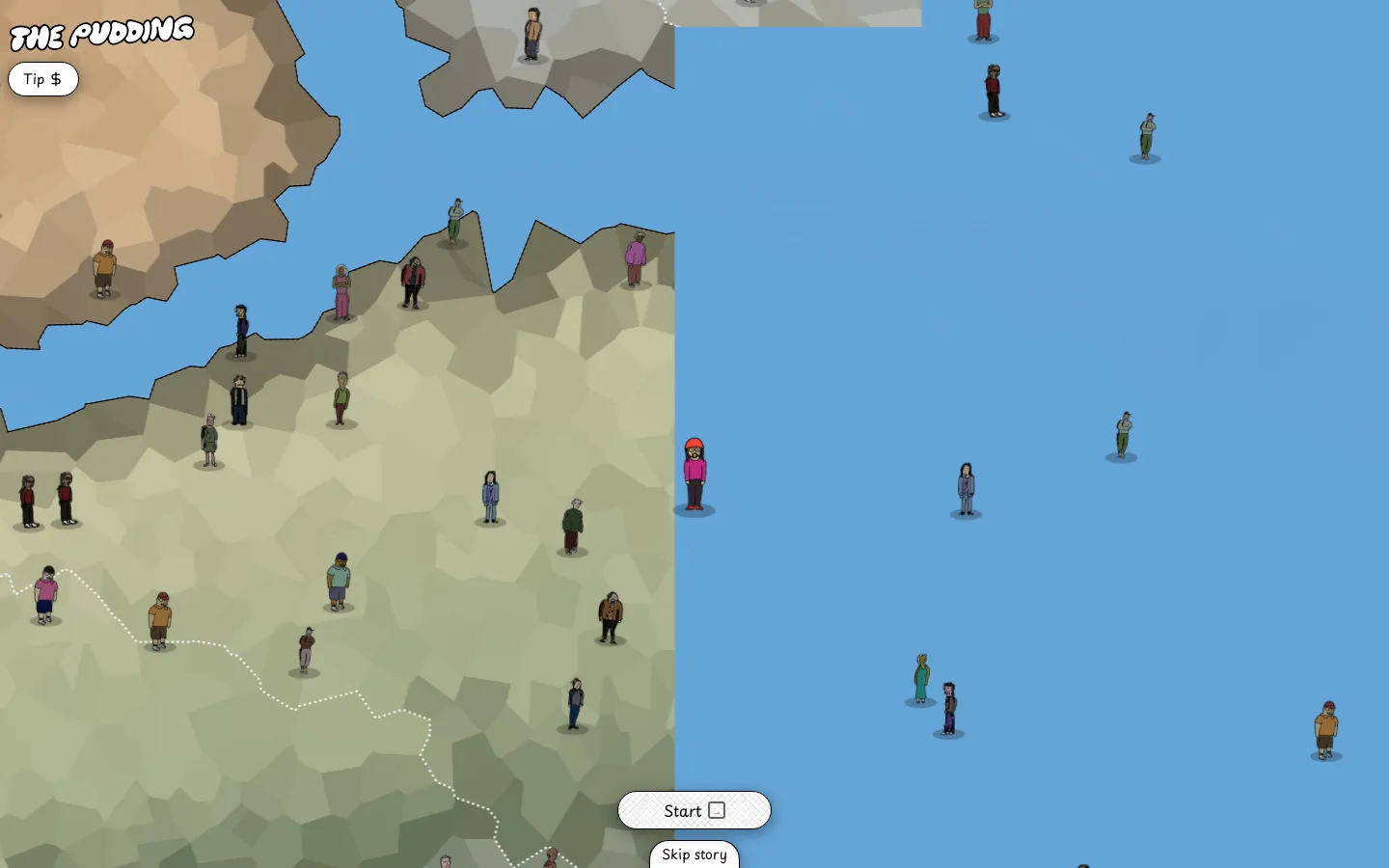
Happy Map reshapes more than 100,000 short accounts of happiness into a navigable landscape. A guided tour explains its unusual compass, then hands over the map so you can wander among meals, relationships, achievements, gifts, hobbies, and other ordinary sparks.
What is Happy Map?
This is a map without countries, roads, or weather. Its terrain is made from brief answers to a simple question: what made you happy recently? Moments nearer the north arrive quickly; those toward the south take time. The east favors things a person can set in motion, while the west holds joys that depend more on someone or something else. Happy Map introduces that grammar through a narrated route before opening the whole landscape for browsing and filtering. Hand-drawn people dot the synthetic geography, helping a giant text corpus feel less like a spreadsheet and more like a crowded park where every stranger has one bright thing to report.
What you can do there
- Follow a guided tour of the happiness landscape
- Explore individual crowdsourced moments
- Filter the map's responses
Why we picked it
The geographic metaphor earns its keep. Instead of ranking happiness or reducing it to one score, the map gives thousands of small moments room to sit beside one another. Its compass also supplies a memorable way to compare instant treats, long projects, private hobbies, and gifts of affection.
How to get the most from it
Take the guided tour first; the north-south and east-west logic is essential. When free exploration begins, use the filter to narrow the crowd, then open individual moments and roam outward. Treat surprising clusters as invitations to look closer, not universal conclusions.
Good to know
This is an interpretive visualization, not a geographic map or a recipe for happiness. Its topic hierarchy and placement use automated classification plus manual cleanup. The original crowdsourced corpus leans heavily toward US participants aged 20 to 40, and later researchers reported duplicate and low-quality entries, so the landscape should not be read as a representative census.
Who made it, and when?
Alvin Chang is the credited creator or organization. The earliest supported launch date we found is February 2026.
Creator’s official page Open Happy MapMore like this
The Pudding

Visual essays that use code, data, and interaction to explain culture unusually well.
Earth Nullschool

A living globe of wind, weather, ocean currents, and atmospheric motion.
The True Size Of…

Drag countries around the map and watch familiar size comparisons fall apart.
MapCrunch

Drop into a random street-level view somewhere in the world and figure out where you landed.