
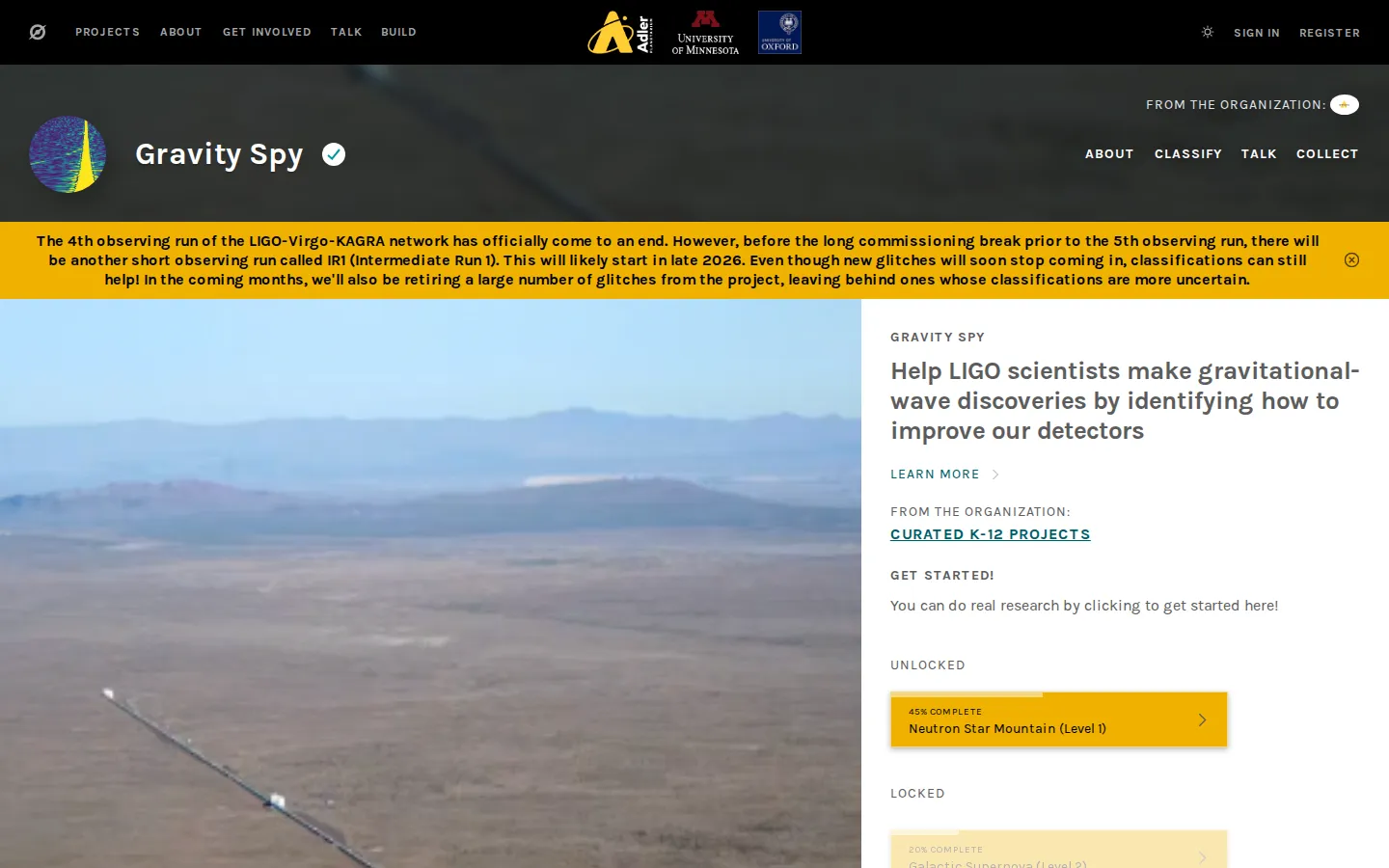
Gravity Spy turns the unwanted hiccups inside LIGO's exquisitely sensitive detectors into a visual classification game with real scientific teeth. You learn the shapes of blips, whistles, scattering, and stranger noise so genuine gravitational-wave searches have a cleaner sky to listen to.
What is Gravity Spy?
The images here are spectrograms of glitches: brief bursts of instrumental or environmental noise, not gravitational waves. Volunteers compare each pattern with known morphologies, paying attention to shape, frequency, timing, and nearby repeats. The project deliberately teaches this vocabulary in stages, then sends harder and less certain cases to experienced participants. Human labels strengthen machine-learning training sets, while the machine side handles volume and returns oddities that deserve another pair of eyes. That loop has produced more than tidy bins; volunteers helped uncover classes with names such as Paired Doves, Helix, and Crown, and published evaluations say the classifications now support LIGO detector-characterization work. The expanded project also asks people to compare the main strain signal with auxiliary channels that may point toward a glitch's physical cause.
What you can do there
- Classify LIGO detector glitches by their time-frequency shape
- Investigate uncertain patterns and possible detector causes
Why we picked it
Few volunteer projects make junk data this charismatic. The spectrograms look like tiny weather systems, musical gestures, or chalk marks, but learning their differences helps scientists separate detector trouble from signals arriving across the Universe. The progressive training is especially smart: it turns a forbidding physics problem into a ladder of visual hunches, then gives skilled volunteers room to notice categories the computer does not already know.
How to get the most from it
Begin with the tutorial and keep the field guide open until the basic silhouettes feel familiar. Compare the feature centered at time zero, then check its frequency and whether similar marks repeat nearby. Pause the cycling durations when a shape is slippery, and use none of the above rather than forcing an unfamiliar glitch into a favorite category. Sign in if you want your performance to unlock the advanced workflows, save examples, or join the discussion in Talk.
Good to know
The LIGO-Virgo-KAGRA fourth observing run has ended, but the project says classifications still matter while it retires easier examples and keeps uncertain ones; a short intermediate run is tentatively expected in late 2026. The current Classify page showed zero active subjects and a three-percent completion figure, while peer-reviewed history documents millions of earlier classifications, so the visible counters are not reliable lifetime totals. A free account is needed for workflow progression, favorites, collections, and Talk. Current subject loading, device support, accessibility, motion, audio, and privacy behavior were not tested in a rendered session.
Who made it, and when?
Gravity Spy collaboration is the credited creator or organization. The earliest supported launch date we found is October 12, 2016.
Creator’s official page Open Gravity SpyMore like this
The Pudding

Visual essays that use code, data, and interaction to explain culture unusually well.
Earth Nullschool

A living globe of wind, weather, ocean currents, and atmospheric motion.
The True Size Of…

Drag countries around the map and watch familiar size comparisons fall apart.
MapCrunch

Drop into a random street-level view somewhere in the world and figure out where you landed.