
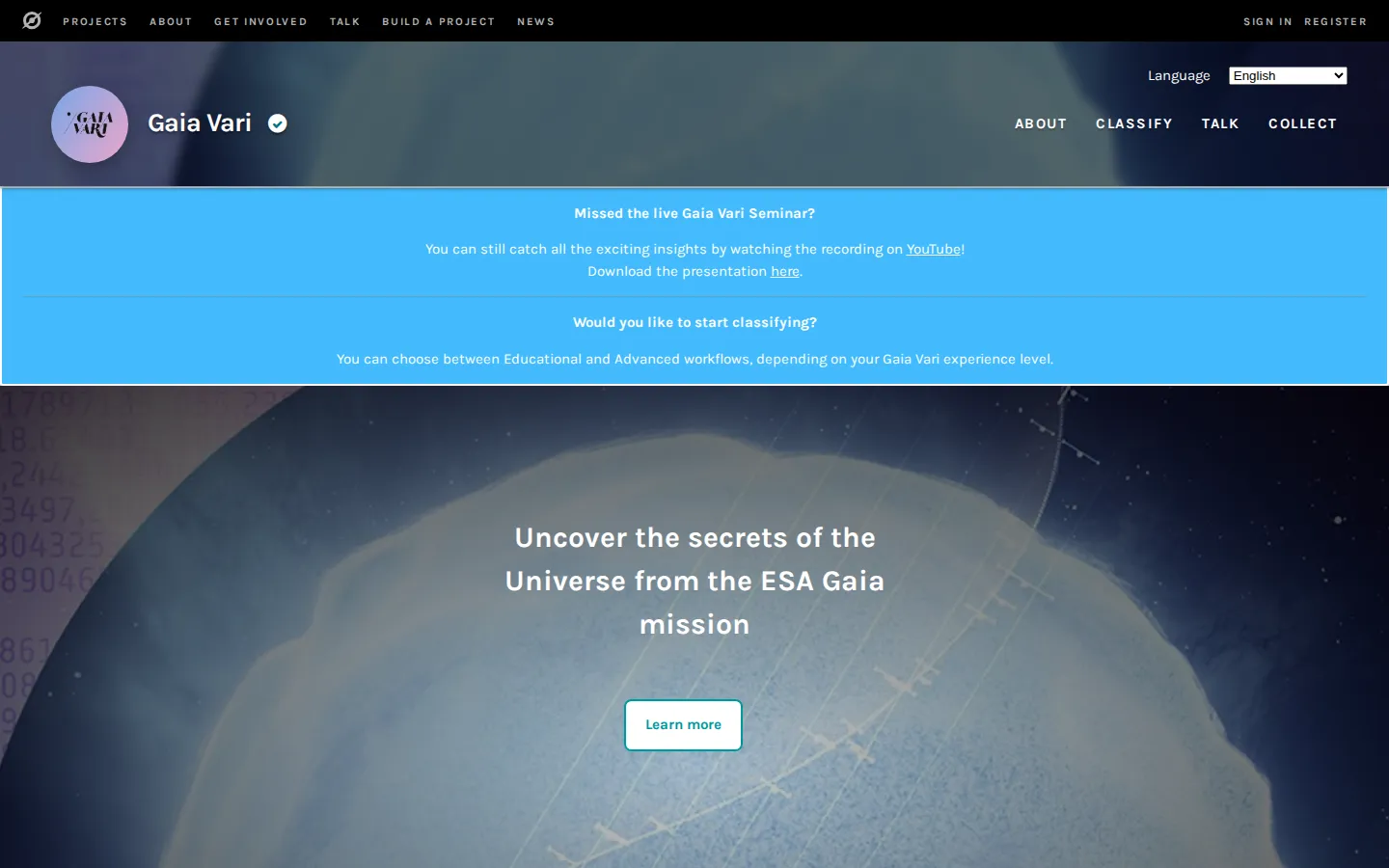
Gaia Vari hands you the brightness history of a star and asks what kind of variable object could be beating underneath the plots. Educational and advanced routes turn real Gaia measurements into a visual classification exercise rather than a gallery of space photographs.
What is Gaia Vari?
The raw material here is change. Gaia has measured the same sources repeatedly, and Gaia Vari packages those observations as several views: brightness over time, the same measurements folded by a candidate period, a position on the Hertzsprung-Russell diagram, and a location in the Galaxy. Together they can reveal the signatures of eclipsing binaries, pulsating Cepheids and RR Lyrae stars, long-period variables, and other classes used in the project's campaigns. A human eye is useful because automated labels can be awkward around unusual shapes and borderline cases. The trick is not to declare a new black hole from one interesting wiggle; it is to compare several diagrams, choose the best-fitting class or none of the above, and let repeated classifications build a stronger signal for the research team.
What you can do there
- Compare stellar light curves and phase-folded plots
- Use color, position, and pattern to choose a variability class
- Flag cases that do not match the offered classes
Why we picked it
Gaia Vari makes an intimidating archive feel like a set of celestial pulse charts. It is the rare science task where pattern recognition, a little patience, and permission to say none of the above are all part of doing the job responsibly.
How to get the most from it
Begin with the Educational workflow and handbook. First inspect the unfurled light curve for drift or repeated rises and dips, then check whether the folded curve tightens that rhythm into a stable shape. Use the Hertzsprung-Russell position and the other context panels as cross-checks rather than choosing from one graph alone. Leave an uncertain case unforced when none of the offered classes fits.
Good to know
No account is required according to ESA, but the live classifier was not interactively tested. The plots are dense and use color, so the accessibility and mobile experience remain unknown. The visible Advanced campaign was complete while the Educational campaign and summary counters displayed conflicting progress signals; subject availability may therefore vary. One volunteer label is not a confirmed stellar classification or discovery, and the later review and publication path was not reproduced.
Who made it, and when?
Sednai and Science Now for the European Space Agency is the credited creator or organization. The earliest supported launch date we found is March 21, 2023.
Creator’s official page Open Gaia VariMore like this
The Pudding

Visual essays that use code, data, and interaction to explain culture unusually well.
Earth Nullschool

A living globe of wind, weather, ocean currents, and atmospheric motion.
The True Size Of…

Drag countries around the map and watch familiar size comparisons fall apart.
MapCrunch

Drop into a random street-level view somewhere in the world and figure out where you landed.