
From Goat to Despite compares two influential English-learning word lists separated by seventy years, then turns their additions and disappearances into a guided data story. The result is playful at word level and cautious about what curriculum lists can actually prove.
What is From Goat to Despite?
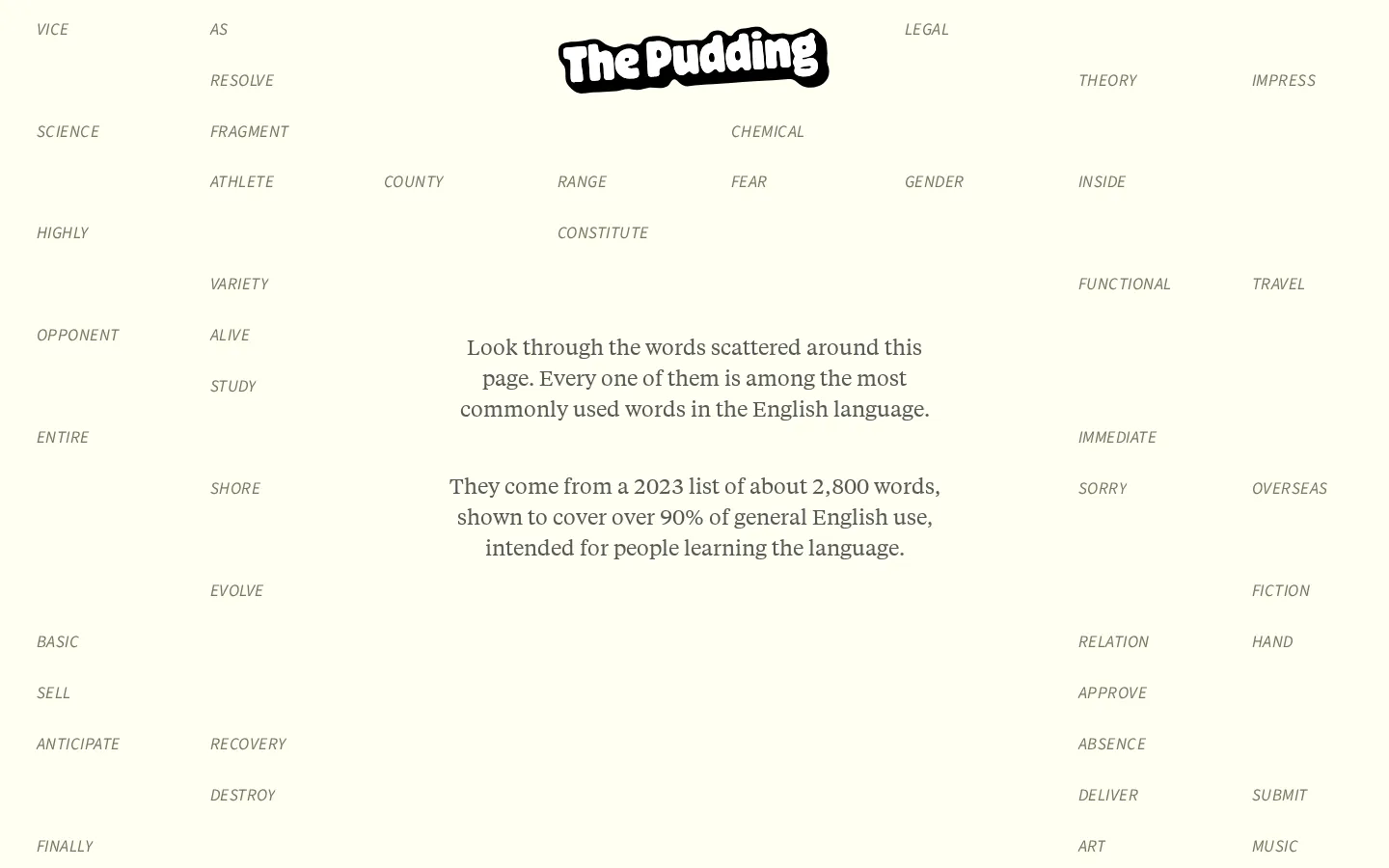
The opening scatters familiar words like loose Scrabble tiles, then gives them jobs: survived both lists, vanished after 1953, or arrived by 2023. From there, the essay pulls back through several lenses. Vocabulary is sorted into semantic neighborhoods, rated from abstract to concrete, and regrouped by part of speech. That is how goat and donkey yield the stage to analysis and despite, while adverbs gather in a particularly busy corner. The charts support a larger argument that essential English has moved away from objects within arm's reach and toward institutions, systems, and calibrated abstractions. Wisely, the methods section also shows the seams: the two lists organize word families differently, coverage estimates vary, and a teaching list is not a perfect portrait of culture.
What you can do there
- Compare words added to and removed from essential English lists
- Explore vocabulary by semantic scope, concreteness, and part of speech
Why we picked it
A dry spreadsheet comparison becomes a cabinet of tiny surprises. Individual word swaps are instantly graspable, while the larger patterns invite a slower second pass and enough methodological detail to keep the clever thesis from floating away.
How to get the most from it
Scroll once for the argument, then return to the charts and full word-list panel for detours. Compare neighboring examples before accepting the broad pattern, and keep the methods caveat in view: removed headwords do not necessarily mean their underlying concepts disappeared.
Good to know
The piece is an interpretation of vocabulary-teaching lists, not a direct measure of everything English speakers thought or did. Hover behavior, the word-list panel, mobile layout, accessibility, and motion were not interactively tested. The publisher says standard Pudding stories have no ads or subscription wall.
Who made it, and when?
Jasmine Nackash is the credited creator or organization. The earliest supported launch date we found is July 2026.
Creator’s official page Open From Goat to DespiteMore like this
The Pudding

Visual essays that use code, data, and interaction to explain culture unusually well.
Earth Nullschool

A living globe of wind, weather, ocean currents, and atmospheric motion.
The True Size Of…

Drag countries around the map and watch familiar size comparisons fall apart.
MapCrunch

Drop into a random street-level view somewhere in the world and figure out where you landed.