
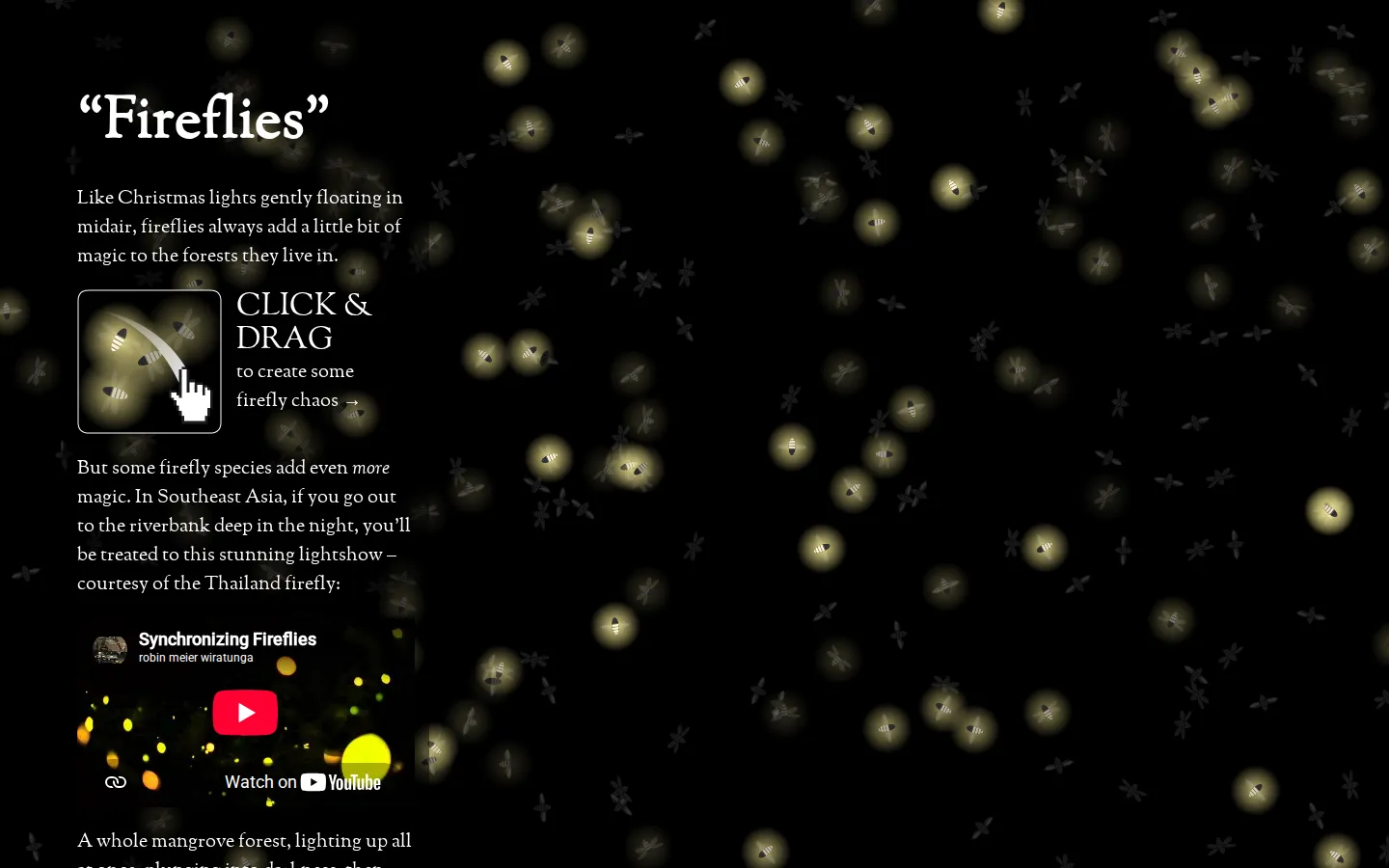
Fireflies is Nicky Case's gentle, glowing lesson in emergence. A swarm begins with clocks out of step, but a tiny local rule gradually pulls nearby flashes together. You can scramble the timing, expose the hidden clocks, and tune the population and coupling to see when scattered blinks become a shared pulse.
What is Fireflies?
The essay gives every firefly a private clock and one neighborly habit: seeing a nearby flash pushes that clock forward. Turn the rule on and the swarm does not snap into order. Small clusters appear first, then broader ripples, then a much larger agreement. Dragging through the field introduces fresh disorder, so the interesting part is not a perfect end state but the way coordination rebuilds itself. The control panel turns that story into a proper sandbox. Raise the swarm from 10 toward 500, reveal the clocks, change their speed, weaken or strengthen each nudge, and shrink or expand the neighborhood where one flash matters. The result is a pocket-sized example of how organization can arise without a boss firefly carrying a clipboard.
What you can do there
- Watch simulated fireflies converge toward synchronized flashing
- Drag through the swarm to scramble its timing
- Change population, clock, nudge, and neighborhood parameters
Why we picked it
The model makes a slippery systems idea both visible and interruptible. You can watch order emerge, shove it off course, and then change the rules that govern recovery. That combination has made the project useful well beyond casual browsing: computer-science workshops, a Microsoft MakeCode activity, a university collective-intelligence course, and a public media lab have all reused it as a teaching object.
How to get the most from it
Switch on neighbor nudging and wait long enough for clusters to form before touching anything else. Then drag through the swarm and watch whether it repairs the rhythm. Reveal the clocks for a clearer causal view, and change only one slider at a time: population, speed, nudge strength, or neighbor radius. The reset buttons make clean comparisons easy.
Good to know
The page is free, open source, and dedicated to the public domain. It uses repeated flashes and animated movement, so it may be uncomfortable for motion- or flicker-sensitive visitors. The source package includes an audio library and a forest-ambience asset, but playback and mute behavior are not documented. Keyboard, screen-reader, reduced-motion, and current mobile behavior are also undocumented. Eight fan translations are linked, with no guarantee that they match the English version exactly.
Who made it, and when?
Nicky Case is the credited creator or organization. The earliest supported launch date we found is 2017.
Creator’s official page Open FirefliesMore like this
Neal.fun

A cabinet of interactive ideas that makes learning feel suspiciously like play.
Quick, Draw!

Doodle against the clock while a neural network tries to guess your subject.
Sandspiel

Paint with sand, water, fire, plants, oil, and other tiny materials that react to one another.
WebGL Fluid Simulation

Push luminous liquid color around the screen and watch digital turbulence behave beautifully.