
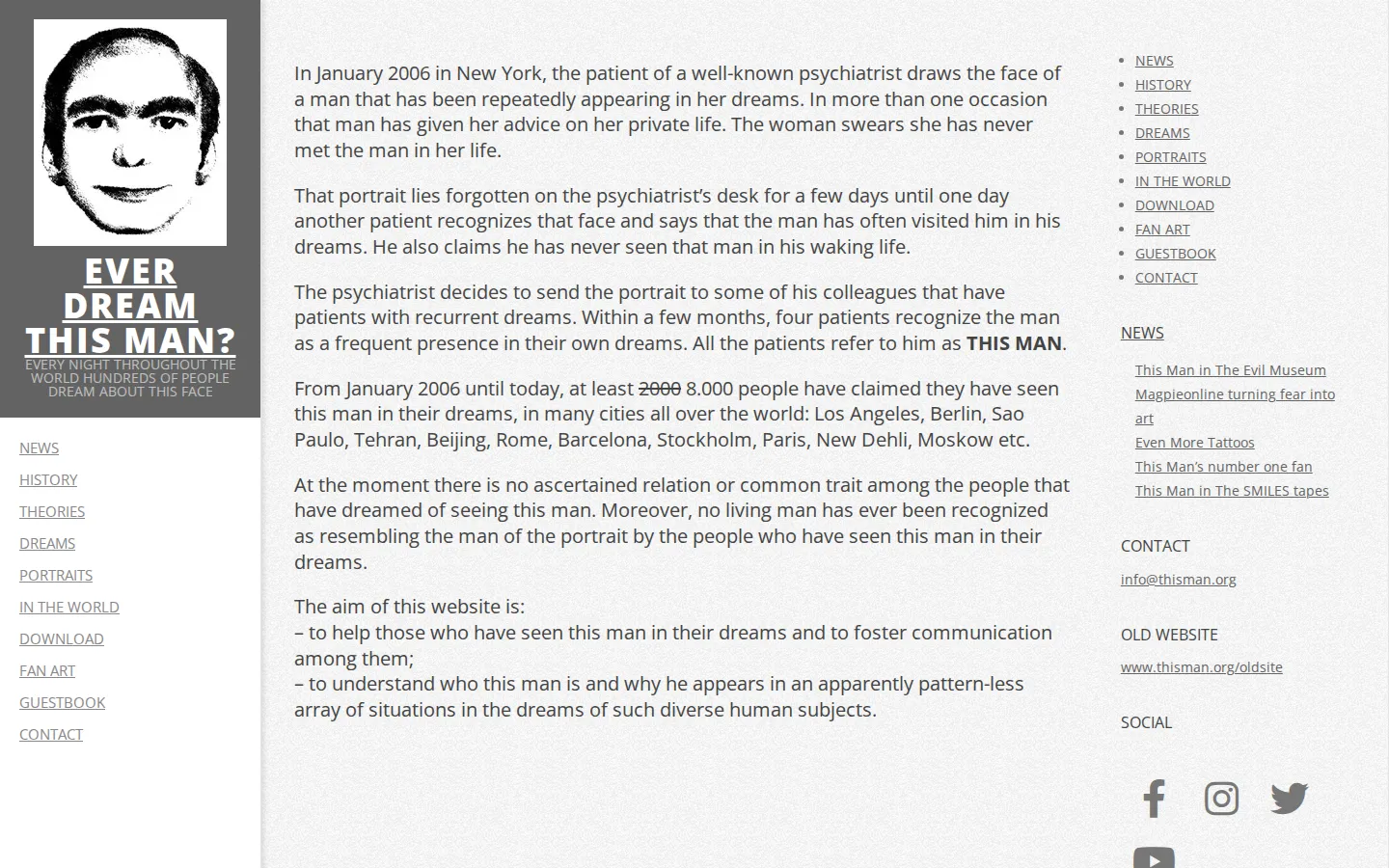
Ever Dream This Man? preserves the shell of a viral mystery built around a face that supposedly appeared in strangers' dreams. The story spread widely because it invited the reader to supply the missing evidence themselves. Independent reporting identified the project as a marketing-driven hoax, making the surviving site more useful as internet folklore than supernatural testimony.
What is Ever Dream This Man??
Ever Dream This Man? is one of the internet's most efficient spooky machines: a hand-drawn face, an impossible claim, and just enough pseudo-documentary texture to make readers wonder whether they have encountered the same thing. The live page still carries its shared-dream premise, but the claim should not be taken as evidence that a real person appears in people's sleep. Andrea Natella's own portfolio lists the project and credits Kook Artgency with collaborators. Contemporary reporting from 20minutos identified the story as a viral-marketing campaign associated with Natella. That reveal changes the pleasure of the site. Instead of asking whether the mystery is true, you can watch how the page makes truth feel briefly plausible: broad language, an emotionally sticky portrait, and a question that recruits the reader's memory. The project belongs beside early creepypasta, chain emails, and other web-native legends that grew through repetition rather than verification. Its enduring power is not the alleged dream phenomenon. It is the small lesson in how a compelling prompt, given enough open space, can turn an invented character into a shared cultural memory.
What you can do there
- Read the project narrative
- Trace an internet-folklore artifact
- Examine how a viral premise is framed
Why we picked it
This Man is worth preserving as a landmark of online folklore and viral storytelling. The premise traveled because it was easy to repeat and difficult to disprove from a distance, while its later context reveals the careful construction underneath the apparent mystery.
How to get the most from it
Read the site as an artifact, then compare its mood and framing with the independent account of the campaign. Notice which details ask you to trust the story and which leave room for your imagination to complete it. Keep the real-world context in view rather than treating the claim as a dream study.
Good to know
The shared-dream premise is fictional, not a verified phenomenon. Independent reporting identified this as a viral-marketing campaign, and the project appears in Andrea Natella's own portfolio. The site is best understood as an internet-art and folklore artifact, not mental-health or paranormal guidance.
Who made it, and when?
Andrea Natella is the credited creator or organization.
Open Ever Dream This Man?More like this
The Library of Babel

Search an imaginary library that contains every possible page of a fixed length—including this sentence somewhere.
FutureMe

Write an email to yourself and choose a date far enough away to make it meaningful.
Wowfold

A paper-plane hangar stocked with darts, gliders, and expert oddballs
Arcane Intern

A magical publishing internship where coffee runs come with sigils.