
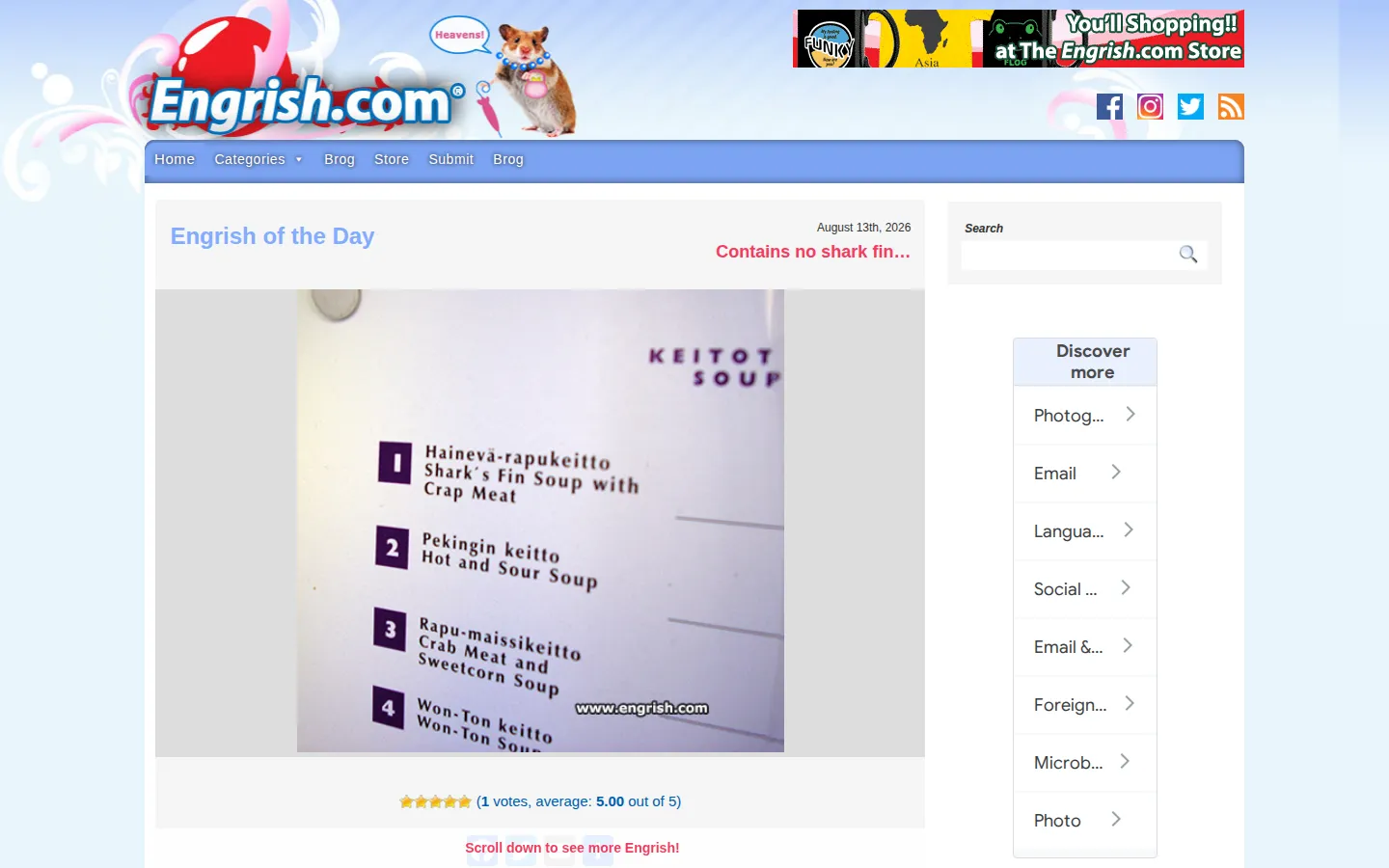
Engrish.com is a long-running collection of photos and text centered on unusual or flawed English in public-facing design. It has the texture of an early internet archive: visitor submissions, short commentary, and a sprawling record of packaging, signs, and slogans that became memorable for reasons their makers may not have intended.
What is Engrish?
Engrish.com presents itself as a record of a phenomenon found in East Asia and elsewhere: English phrases used in product design, advertising, and public settings in ways that can feel odd to fluent readers. The site’s FAQ says the collection began in 1996 and uses examples gathered by its webmaster or sent in by contributors. That makes it an unusually durable piece of web culture, built less like a polished magazine than a continuing cabinet of found material. The archive is most interesting when viewed as evidence of how language, branding, and visual style travel. English can be used for sound, mood, or a modern-looking surface as much as for literal communication; a phrase may be perfectly legible as design while landing differently for a reader who understands every word. That tension is the historical subject beneath the site's jokes. It also needs a careful frame. The site says it does not intend to ridicule people, but Pacific Citizen reported substantial criticism about humor made from language and cultural difference. The most worthwhile visit is therefore not a hunt for targets. Treat it as a dated, participatory archive of globalized design, and keep the human beings behind the words in view.
What you can do there
- Browse submitted examples
- Read short accompanying commentary
- Use the site as a historical web archive
Why we picked it
Engrish.com is significant as a remarkably early, persistent example of a community-built internet archive. Its subject sits at the intersection of language, commerce, visual culture, and web humor, which makes the collection more revealing than a simple gallery of strange phrases.
How to get the most from it
Browse slowly and read the surrounding context rather than treating individual images as punchlines detached from their setting. Notice where English functions as decoration, branding, or attempted communication, and keep in mind that mistakes in a second language do not measure a person's intelligence.
Good to know
This archive's theme can be culturally sensitive. Its FAQ says the site aims to focus on the phenomenon rather than mock people, while independent reporting documented serious objections to that framing. It is not a language-learning resource or a neutral guide to translation quality.
Open EngrishMore like this
The Library of Babel

Search an imaginary library that contains every possible page of a fixed length—including this sentence somewhere.
FutureMe

Write an email to yourself and choose a date far enough away to make it meaningful.
Wowfold

A paper-plane hangar stocked with darts, gliders, and expert oddballs
Arcane Intern

A magical publishing internship where coffee runs come with sigils.