
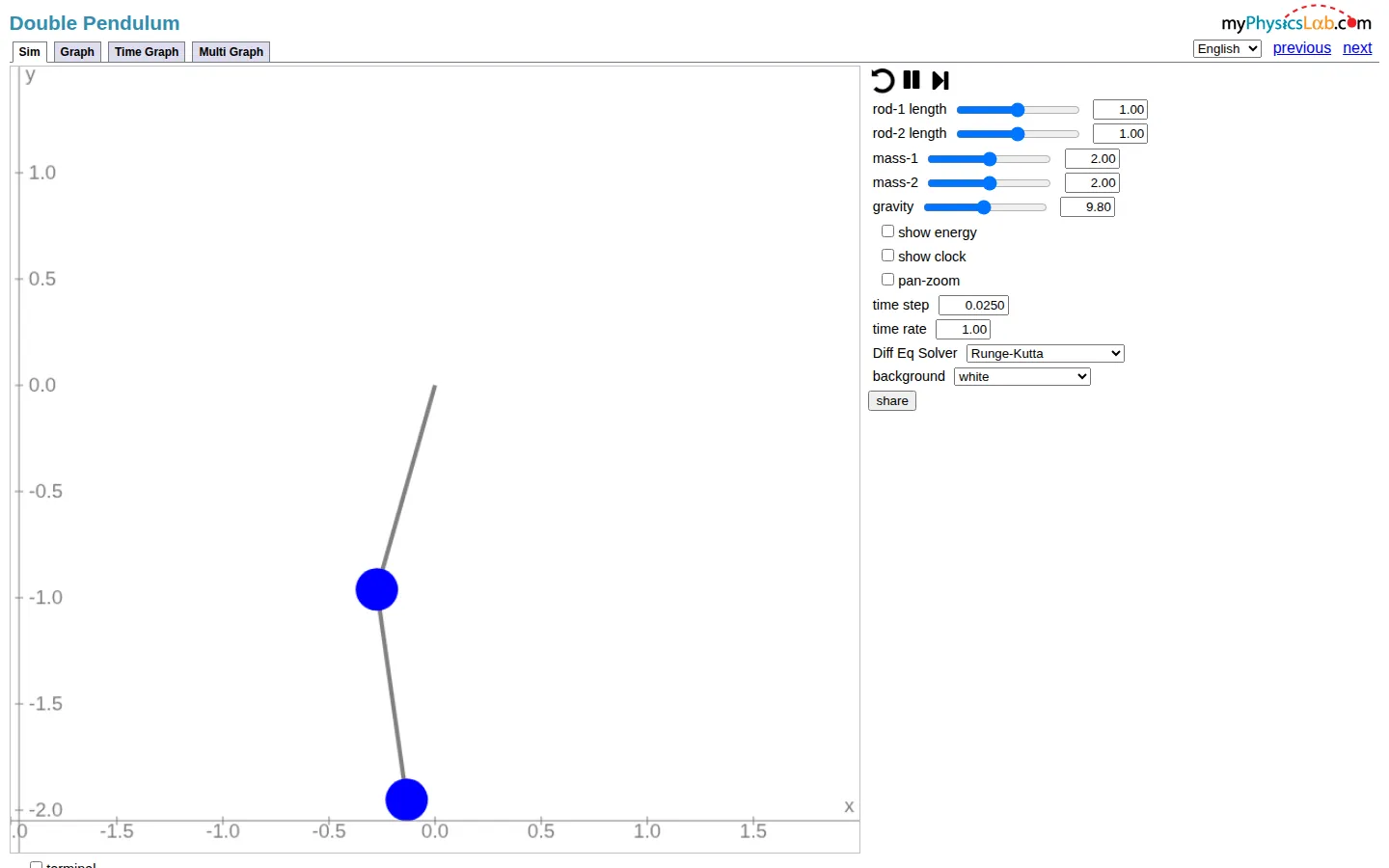
myPhysicsLab's Double Pendulum pairs an adjustable simulation with unusually complete mathematical notes. Drag either mass, change gravity, rod lengths, or masses, and compare the motion through simulation, phase, time, and multi-graph views. Small swings trace orderly linear patterns; larger releases turn the same two rods into a compact demonstration of deterministic chaos.
What is Double Pendulum?
The friendly trick here is that the apparatus never changes: two ideal rods, two point masses, one fixed pivot. Only the starting angles or a handful of parameters move, yet the behavior can slide from tidy oscillation into a path that looks like the machine has misplaced its manners. Graph tabs let the spectacle become data, while the long article below the simulation walks from positions and forces through the coupled equations and into the Runge-Kutta form used for numerical motion. It is a rare interactive that lets a quick drag become either a five-minute visual experiment or a serious afternoon with the derivation.
What you can do there
- Drag the pendulum masses to choose starting positions
- Change masses, gravity, and rod lengths
- Compare motion in simulation and graph views
- Read the Newtonian derivation and numerical method
Why we picked it
The page does not hide the physics behind a glossy animation. It places the moving model, adjustable variables, graph views, idealizing assumptions, source code, and equations in one continuous path. That combination makes the surprise of chaotic motion useful rather than merely pretty, which is why educators have folded this exact simulation into lessons about sensitivity to initial conditions.
How to get the most from it
Start with both rods near vertical and watch the comparatively orderly small-angle motion. Then drag one mass to a larger angle and release it. Repeat from a nearly identical position, switching to a graph view to compare how the trajectories separate. Change only one quantity at a time—one mass, one rod length, or gravity—so the cause of each difference stays legible. The derivation below is best approached after the motion has given each symbol something concrete to describe.
Good to know
This is an idealized numerical model: the rods are massless and rigid, the bobs are point masses, and real friction or construction flaws are outside that stated setup. The page was first published in February 2002 and revised in December 2023; the broader open-source project moved from Java to JavaScript and then TypeScript. Expect continuous motion and dense equations. Device behavior, reduced-motion support, audio, and assistive-technology compatibility were not verified.
Who made it, and when?
Erik Neumann is the credited creator or organization. The earliest supported launch date we found is February 2002. A documented update was recorded December 19, 2023.
Creator’s official page Open Double PendulumMore like this
Neal.fun

A cabinet of interactive ideas that makes learning feel suspiciously like play.
Quick, Draw!

Doodle against the clock while a neural network tries to guess your subject.
Sandspiel

Paint with sand, water, fire, plants, oil, and other tiny materials that react to one another.
WebGL Fluid Simulation

Push luminous liquid color around the screen and watch digital turbulence behave beautifully.