
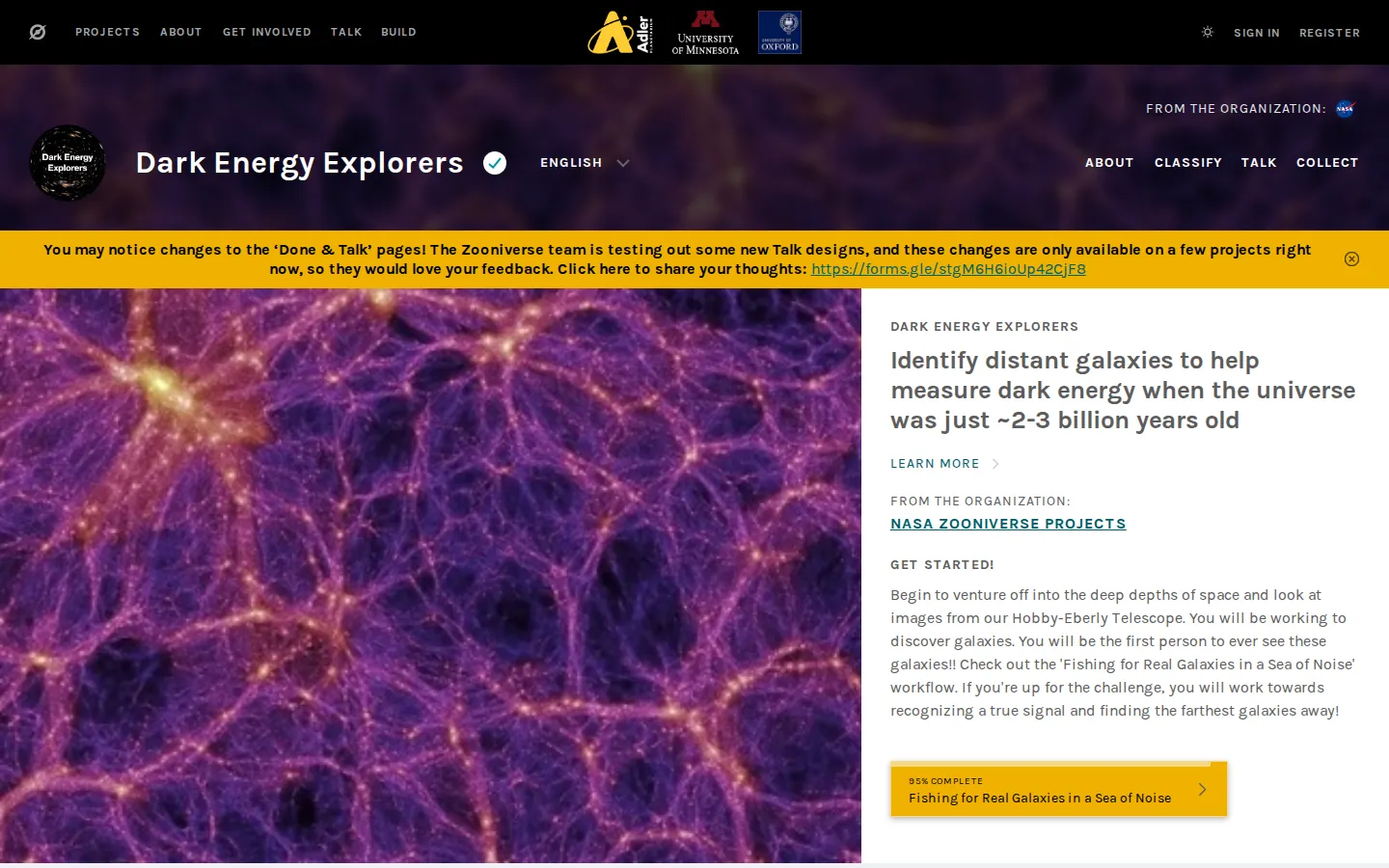
Dark Energy Explorers turns a hard astronomy problem into a compact visual judgment: is that faint blip a distant galaxy, a nearby object, or plain old telescope noise? Each answer helps HETDEX clean a vast spectral survey and sharpen its map of the early universe.
What is Dark Energy Explorers?
The screen is less space-poster spectacular than gloriously forensic. HETDEX collects spectra without preselecting targets, leaving a haystack of tiny signals, artifacts, and foreground objects. Volunteers examine small image and spectral cutouts, then decide whether a candidate looks real and, in some workflows, whether it is nearby or extremely distant. Those judgments have already formed a large visually vetted dataset. Researchers use it both to reject false positives and to train software that can carry the pattern-recognition work across millions more sources. The scientific prize is a cleaner three-dimensional map of galaxies from an early chapter of the universe, built to test how cosmic expansion changed over time.
What you can do there
- Inspect telescope image and spectral cutouts
- Separate real galaxy signals from noise
- Distinguish distant galaxies from nearby objects
Why we picked it
It gives ordinary pattern recognition a surprisingly large lever. The task is simple enough to learn quickly, yet the difference between a real signal and a convincing speck of noise is exactly where human eyes have been useful. There is also a nice scale shift: one cautious swipe joins a map measured in billions of light-years.
How to get the most from it
Start with the tutorial, then compare the bright spot's location and shape across every cutout before deciding. In the noise workflow, look for a signal that stays structurally consistent instead of reacting to one dramatic pixel. Use a phone for quick swipe classifications or the desktop site when you want more room to study the evidence.
Good to know
The project is free and in English, with desktop access and Zooniverse mobile apps. The live classifier was not executed during this review, so account requirements, keyboard access, screen-reader behavior, audio, and feedback after submission remain untested. The public page currently pairs a 96 percent progress figure with zeroed activity counters; treat those displays as unsettled rather than proof that work is unavailable. Expect scientific cutouts and plots, not conventional galaxy portraits.
Who made it, and when?
Hobby-Eberly Telescope Dark Energy Experiment is the credited creator or organization. The earliest supported launch date we found is February 23, 2021.
Creator’s official page Open Dark Energy ExplorersMore like this
The Pudding

Visual essays that use code, data, and interaction to explain culture unusually well.
Earth Nullschool

A living globe of wind, weather, ocean currents, and atmospheric motion.
The True Size Of…

Drag countries around the map and watch familiar size comparisons fall apart.
MapCrunch

Drop into a random street-level view somewhere in the world and figure out where you landed.