
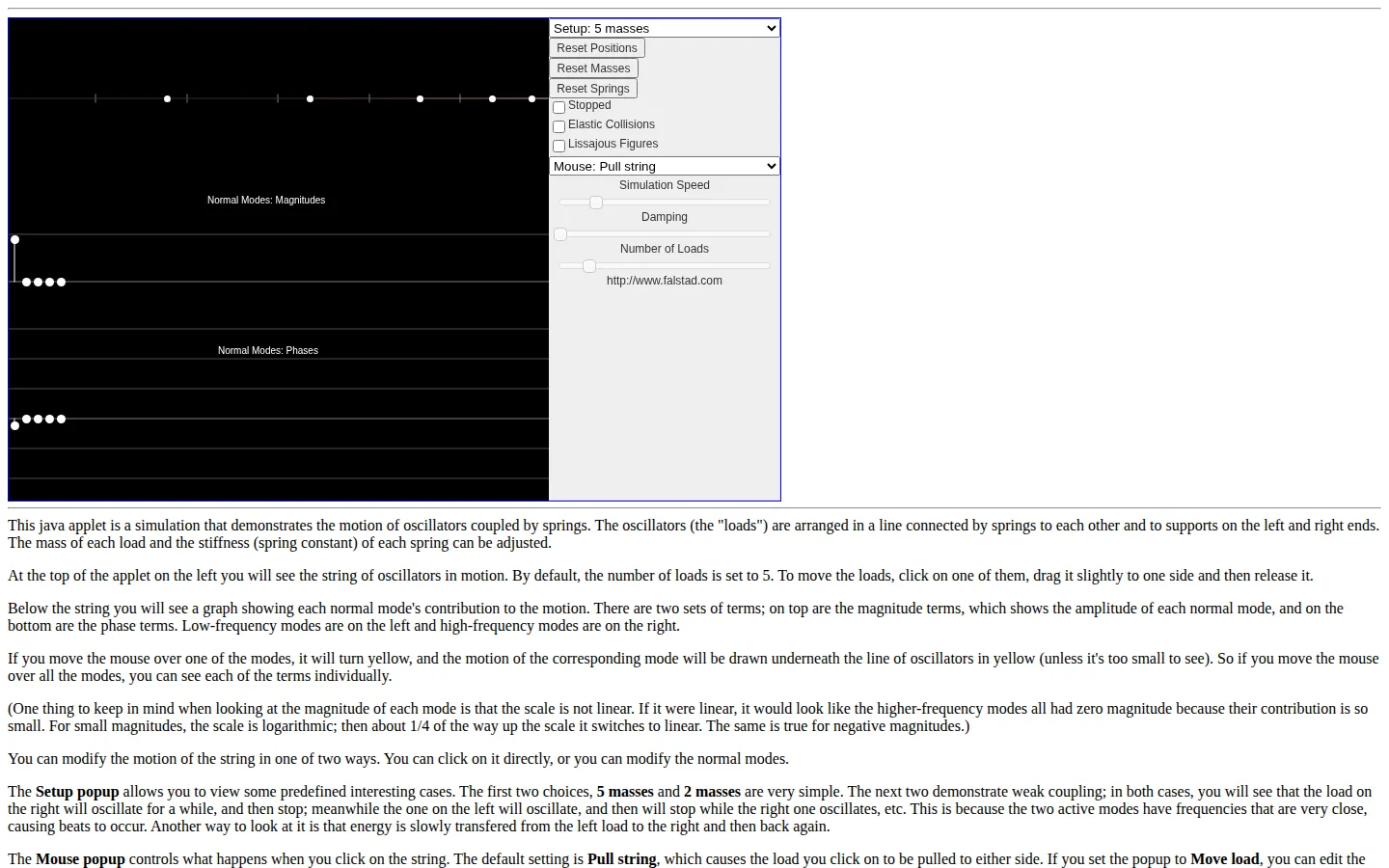
Coupled Oscillation Simulation turns a row of spring-linked masses into a compact laboratory for normal modes. The documented controls let you disturb the line, alter its physical parameters, and connect the visible motion to magnitude and phase readouts beneath it.
What is Coupled Oscillation Simulation?
The top view presents loads tethered by springs between two supports; below it, a mode graph breaks the motion into low- and high-frequency contributions. That split view is the main attraction. A messy-looking wiggle can be read as a recipe of amplitudes and phases instead of a single mysterious shudder. The page also documents a generous bench of experiments: change individual masses or spring constants, add damping, vary the number of loads, pause the motion, switch collision behavior, or call up weak-coupling presets where energy appears to migrate back and forth. With two active modes, a Lissajous option adds another window into the system's rhythm.
What you can do there
- Pull spring-connected loads and observe the resulting motion
- Adjust masses, springs, damping, speed, and load count
- Compare normal-mode magnitude and phase
- Try weak coupling, collisions, and Lissajous figures
Why we picked it
It makes an abstract decomposition feel mechanical and inspectable. The normal-mode panel gives the eye somewhere useful to go after the springs start dancing, while the weak-coupling cases supply a particularly satisfying lesson in beats and energy transfer without requiring a physical lab bench.
How to get the most from it
Start with the default line and pull one load slightly off center. Hover across the documented mode terms to isolate their contributions, then try a weak-coupling preset and watch for the motion to pass between the end loads. Add damping last so you can see which patterns fade fastest.
Good to know
This is instructional simulation territory, not a certified engineering model. The current page says the applet was converted to JavaScript, though older independent catalog records still mention Java. Live browser behavior, device support, accessibility, sound, and numerical accuracy were not tested, and no screenshot was captured.
Who made it, and when?
Paul Falstad is the credited creator or organization.
Creator’s official page Open Coupled Oscillation SimulationMore like this
Neal.fun

A cabinet of interactive ideas that makes learning feel suspiciously like play.
Quick, Draw!

Doodle against the clock while a neural network tries to guess your subject.
Sandspiel

Paint with sand, water, fire, plants, oil, and other tiny materials that react to one another.
WebGL Fluid Simulation

Push luminous liquid color around the screen and watch digital turbulence behave beautifully.