
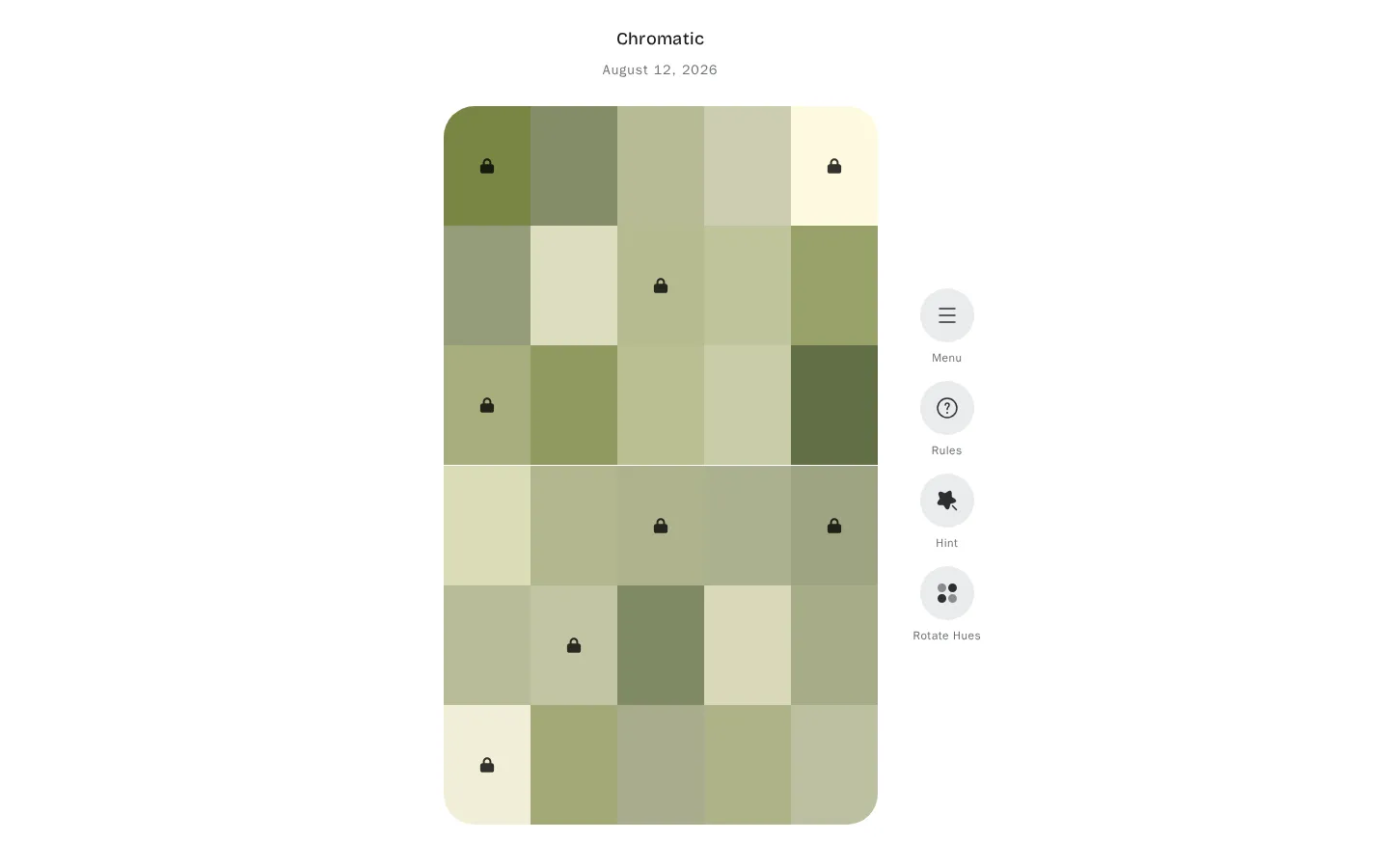
Chromatic makes color ordering into a small spatial puzzle: rearrange a scrambled field of shades until the whole grid reads as one continuous gradient instead of a pocket of visual static.
What is Chromatic?
Chromatic is built around an appealingly narrow challenge: a color gradient has been shaken loose, and the tiles need to find their way home. Some squares stay locked as landmarks while the remaining colors can be exchanged by tap or drag. The task is less about naming colors than sensing whether neighboring tiles are moving naturally through hue, saturation, and brightness. That gives the puzzle a tactile design-studio flavor without turning it into a tool. Feyder.co lists it as a daily color-sorting game, and Sidebar also selected it for its design-focused games roundup. A visible random-level option suggests a quick detour when the day’s arrangement is not enough.
What you can do there
- Swap color tiles to repair a gradient
- Use locked tiles as reference points
Why we picked it
The core idea is unusually legible: one broken gradient, a few reliable anchors, and just enough uncertainty to make a correct edge feel earned. It turns a familiar visual property into a tidy little reasoning problem.
How to get the most from it
Begin at the fixed tiles and compare the shades immediately beside them. Build an outside edge before filling the center, then scan both rows and columns for a transition that suddenly looks too sharp or too muddy.
Good to know
This run did not manipulate the board or settings. The page visibly offers random-level, puzzle-size, relaxed-mode, effects, and sound controls, but their current behavior and any accessibility accommodations were not verified. The challenge relies on seeing subtle color shifts.
Open ChromaticMore like this
The Library of Babel

Search an imaginary library that contains every possible page of a fixed length—including this sentence somewhere.
FutureMe

Write an email to yourself and choose a date far enough away to make it meaningful.
Wowfold

A paper-plane hangar stocked with darts, gliders, and expert oddballs
Arcane Intern

A magical publishing internship where coffee runs come with sigils.