
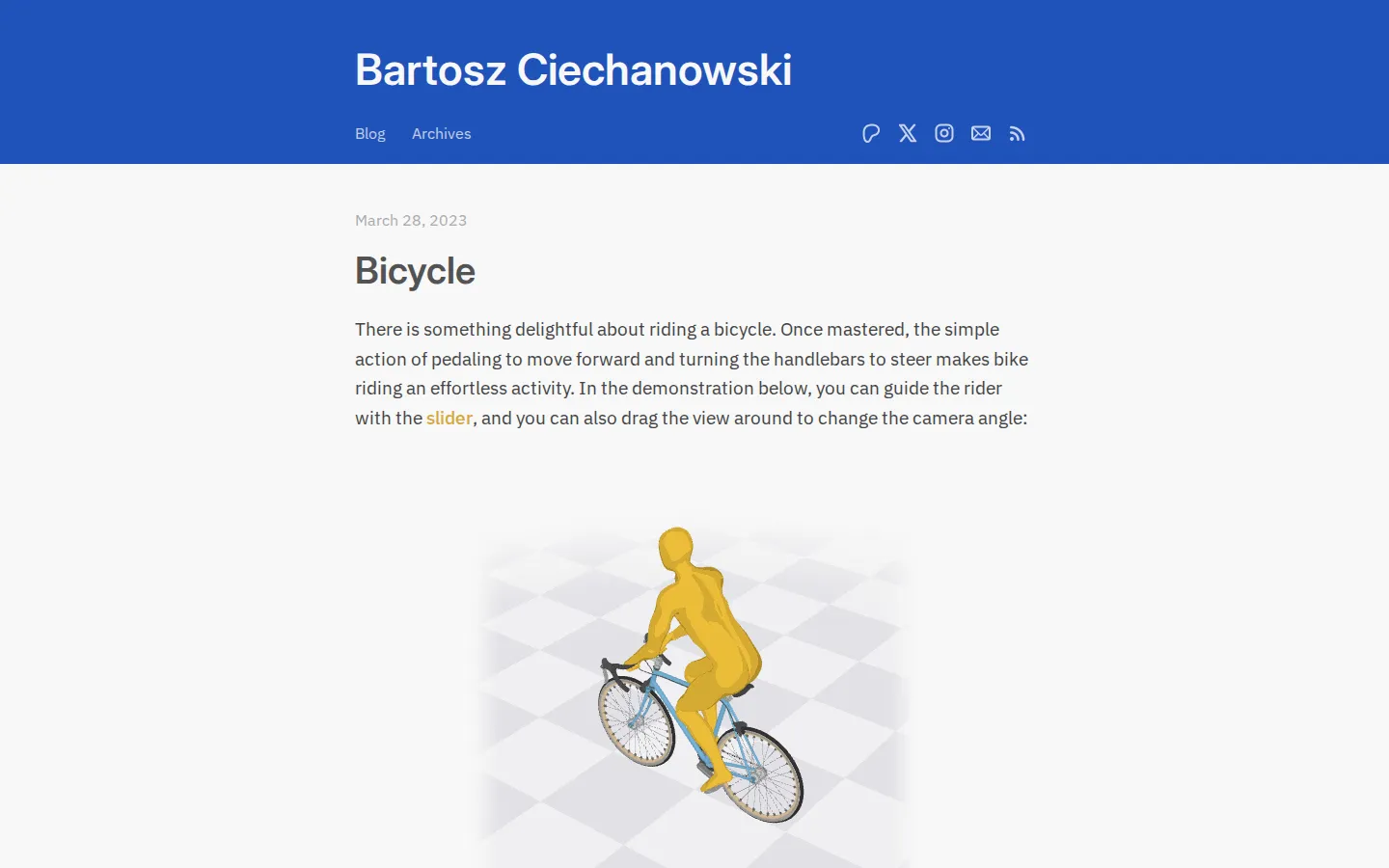
Bicycle turns a familiar machine into a sprawling physics bench. Adjustable diagrams track forces through pedaling, braking, tire contact, steering, spokes, and frame tubes, revealing why two wheels that look simple can keep several branches of mechanics pleasantly busy.
What is Bicycle?
The opening wooden boxes are a clever warm-up: before a rider appears, the page establishes force, acceleration, balance, and torque with controls simple enough to interrogate. Then the arrows migrate onto the bicycle. They follow weight into the road, pedaling into the rear contact patch, braking back through the tire, and steering into the side forces that rescue a lean. The final stretch opens the hardware itself, showing why spokes prefer tension and why hollow tubes and triangular frame geometry carry load without turning the bike into a steel anvil. Simplifications are called out, and the further-reading list points beyond the demonstrations when the physics stops being tidy.
What you can do there
- Adjust riders, forces, motion, and materials with sliders
- Rotate views and inspect changing force vectors
- Follow bicycle loads from road contact to wheels and frame
Why we picked it
A bicycle hides its sophistication by working in plain sight. This article makes the missing layer visible without flattening it into one magical explanation for balance. Independent visualization and engineering outlets singled out the small-step structure, responsive force arrows, and unusual depth, all of which make it a rare explainer that rewards both cyclists and physics-minded tinkerers.
How to get the most from it
Do not race to the bicycle. Spend a few minutes with the early box simulations so the force arrows have a grammar. Once the rider appears, change one control at a time and follow a single color or load path. Save the wheel and frame sections for a second sitting if spoke tension and beam stress begin to merge into one large vector salad.
Good to know
This is a long conceptual physics article, not a repair, fitting, or riding-safety guide. Several models deliberately simplify friction, materials, and structural loads, and the author links specialist sources for deeper treatment. The article is publicly readable and invites voluntary Patreon support; audio, ads, data collection, touch behavior, keyboard access, screen-reader support, reduced-motion handling, and a global pause control were not verified.
Who made it, and when?
Bartosz Ciechanowski is the credited creator or organization. The earliest supported launch date we found is March 28, 2023.
Creator’s official page Open BicycleMore like this
Neal.fun

A cabinet of interactive ideas that makes learning feel suspiciously like play.
Quick, Draw!

Doodle against the clock while a neural network tries to guess your subject.
Sandspiel

Paint with sand, water, fire, plants, oil, and other tiny materials that react to one another.
WebGL Fluid Simulation

Push luminous liquid color around the screen and watch digital turbulence behave beautifully.