
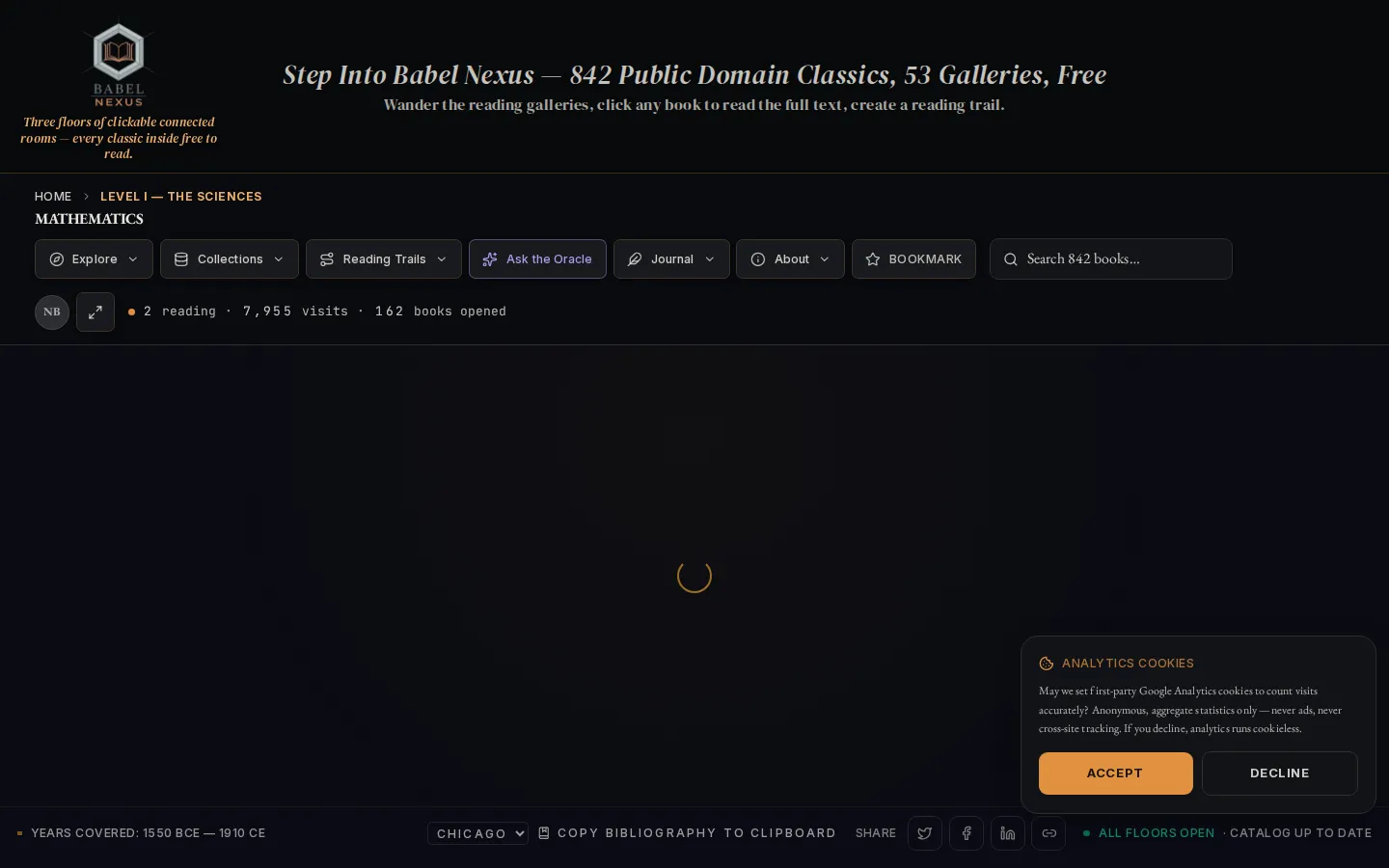
Babel Nexus Index replaces the flat catalog with a set of connected rooms. Choose a subject, inspect the classics on its shelves, then follow a doorway into the field that fed it or grew from it. Full texts open through established public archives, while maps, bookmarks, trails, and an optional Oracle give the collection several ways to wander.
What is babelnexus.com?
The signature idea is architectural. Astronomy, Epics, Philosophy, and dozens of other subjects become hexagonal galleries, with doors standing in for argued connections between fields. A staircase moves between science, literature and art, and wisdom; a whole-floor map provides the bird's-eye version when room-to-room wandering starts to feel like getting pleasantly lost in the stacks. Books are not trapped inside the scenery. Gallery shelves point outward to complete texts at Project Gutenberg, the Internet Archive, or Wikisource, and plain master lists offer a conventional fallback. Search jumps to a title or room, bookmarks stay in the browser, and Reading Trails let you arrange discoveries into a path that can be shared. An optional Oracle answers collection-focused questions and points back toward the books on the shelves. The project is visibly growing, sometimes faster than its labels keep pace: current pages disagree about whether the collection contains 820, 837, or 842 works. Treat those numbers as moving shelf counts, not a settled inventory. The more durable appeal is the structure itself, which encourages a reader to notice why one body of thought opens into another.
What you can do there
- Browse classics inside hexagonal subject galleries
- Follow doors between related fields
- Open full texts from established public archives
- Build and share an ordered reading trail
- Ask the collection's Oracle a plain-language question
Why we picked it
Most ebook indexes ask for a title you already know. Babel Nexus makes subject adjacency the interface, so browsing becomes part map-reading and part library ramble. The Astronomy sample alone can lead from Galileo and Kepler toward Physics, Mathematics, or a prepared trail about the rise of scientific method. That is a more interesting invitation than another grid of covers.
How to get the most from it
Begin with a familiar room such as Astronomy, open one shelf item, then take a doorway into a neighboring subject before reaching for search. Switch to the whole-floor map when you want orientation, and use a plain master list if the visual explorer feels busy. Build a Reading Trail only after collecting a few stops; the route is more useful when it records an actual line of curiosity.
Good to know
The interactive explorer requires JavaScript and permits framing only on its own origin, so expect to open it directly. Full texts come from outside archives and may vary in format. Current pages show conflicting collection totals. The service is free and accountless, and it uses aggregate analytics plus a cookie notice.
Who made it, and when?
Nishan Stepak is the credited creator or organization. The earliest supported launch date we found is March 2026.
Creator’s official page Open babelnexus.comMore like this
The Library of Babel

Search an imaginary library that contains every possible page of a fixed length—including this sentence somewhere.
FutureMe

Write an email to yourself and choose a date far enough away to make it meaningful.
Wowfold

A paper-plane hangar stocked with darts, gliders, and expert oddballs
Arcane Intern

A magical publishing internship where coffee runs come with sigils.