
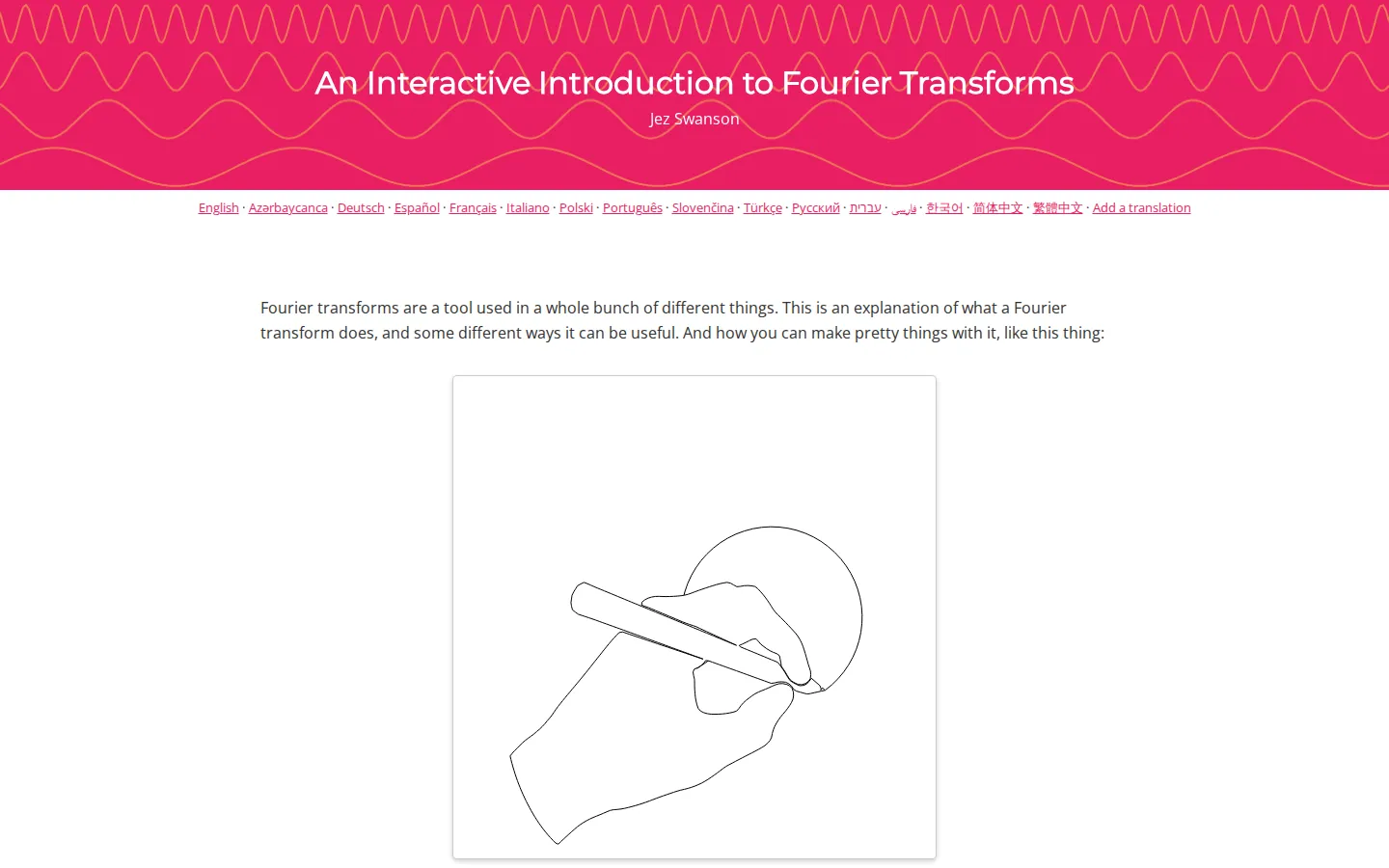
This generous scroll turns Fourier transforms from a wall of notation into waves you can inspect, drawings you can decompose, and circles that chase one another into recognizable shapes. It starts with intuition, then connects the idea to sound and image compression without pretending to be a formal math course.
What is An Interactive Introduction to Fourier Transforms?
The lesson builds its idea in layers. Simple and square waves introduce frequency components; visible controls invite changes to the number of components; an epicycle section turns those components into nested circles; and a JPEG section connects the same intuition to image data. The page is unusually good at letting one picture prepare you for the next. By the time the circles begin tracing drawings, a famously abstract operation feels less like a spell and more like an extremely organized pile of wiggles.
What you can do there
- Read a visual introduction to frequency decomposition
- Adjust visible wave and epicycle examples
- Draw a shape for Fourier-style approximation
Why we picked it
It gives a difficult concept a memorable physical vocabulary without sanding away its strangeness. The progression from sound to doodles to image blocks is specific, coherent, and playful, while the independent educational recommendation confirms that the approachable treatment is useful beyond its visual charm.
How to get the most from it
Read from the top once instead of jumping straight to the fanciest circles. Change one visible slider at a time, compare the rough and refined approximations, and draw a simple outline before trying a complicated one. Save the linked deeper readings for after the main visual idea clicks.
Good to know
The article deliberately leaves equations for later, so bring a second resource if you need derivations or implementation details. Several demonstrations include sound controls, and the page is long enough to reward an unhurried visit. Translations are available in many languages, while live device and accessibility behavior still needs hands-on verification.
Who made it, and when?
Jez Swanson is the credited creator or organization.
Creator’s official page Open An Interactive Introduction to Fourier TransformsMore like this
Neal.fun

A cabinet of interactive ideas that makes learning feel suspiciously like play.
Quick, Draw!

Doodle against the clock while a neural network tries to guess your subject.
Sandspiel

Paint with sand, water, fire, plants, oil, and other tiny materials that react to one another.
WebGL Fluid Simulation

Push luminous liquid color around the screen and watch digital turbulence behave beautifully.