
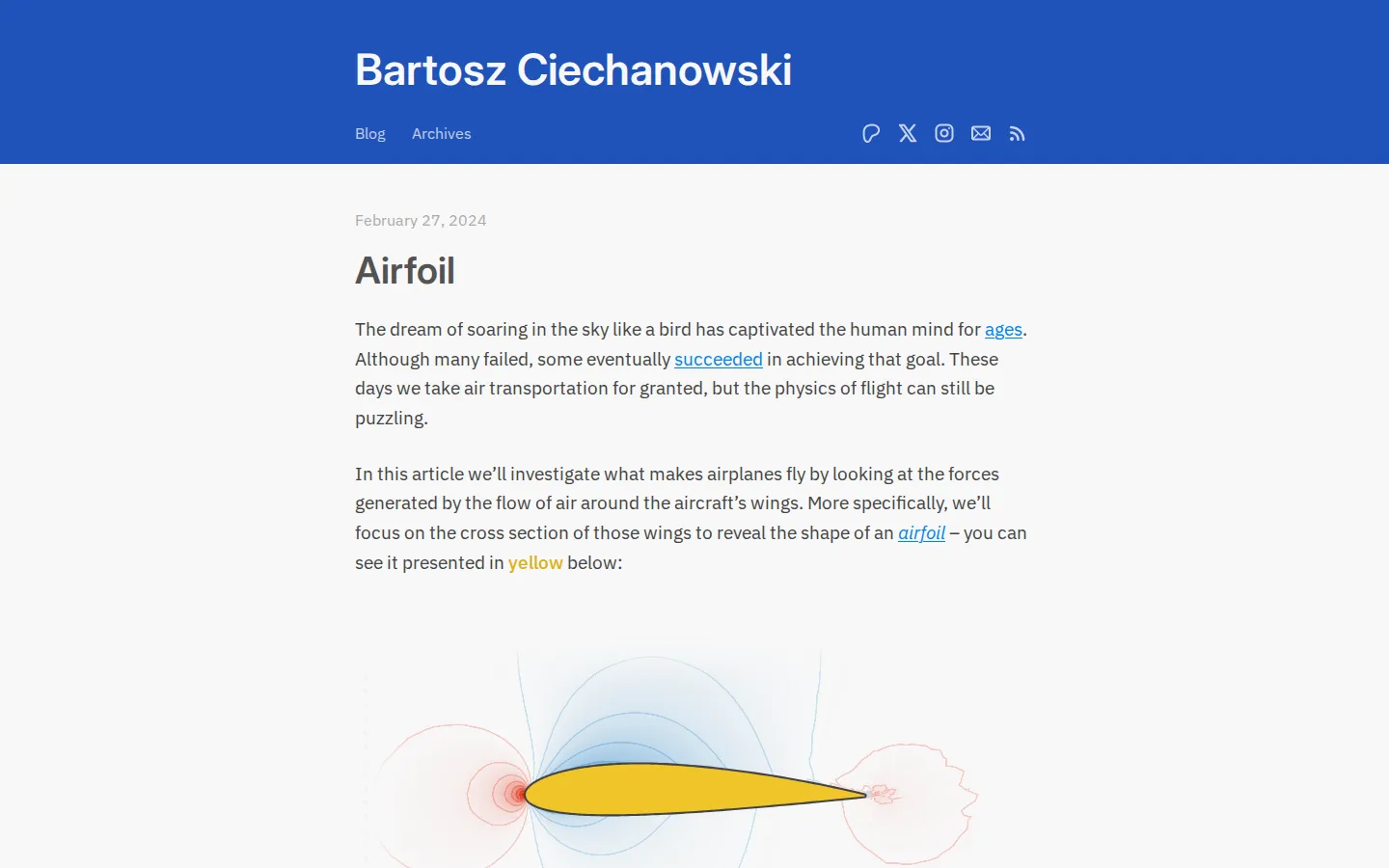
Airfoil is Bartosz Ciechanowski's enormous visual explanation of how air moving around a wing produces force. It starts below the usual airplane diagram, with particles, pressure, and flow, then assembles those pieces into lift, drag, angle of attack, stall, viscosity, and airfoil shape. The reward is intuition built from moving pictures instead of a slogan about faster air.
What is Airfoil?
The page treats an airplane wing as the destination, not the starting assumption. First it asks what air is doing at tiny and large scales, then maps pressure and velocity around simple objects before introducing the familiar rounded nose and sharp trailing edge of an airfoil. The described demonstrations let readers alter fluid properties, place markers in a flow, change angle of attack, and reshape the foil. By the time stall and flow separation arrive, they feel like consequences of the model rather than vocabulary dropped from the sky.
What you can do there
- Follow a visual explanation of lift and airflow
- Manipulate the article's described flow and airfoil controls
Why we picked it
Airfoil takes a famously oversimplified question and gives it enough room to breathe. Its strongest move is the sequence: pressure, flow, geometry, and force are made legible before the article asks them to explain flight. Independent readers have praised the slider-driven graphics for keeping an unusually long technical essay engaging, and that depth makes this a rare web page worth scheduling rather than merely bookmarking.
How to get the most from it
Read from the beginning even if the later wing diagrams look more tempting. Change one slider slowly, watch the pressure or flow markers, and then return to the surrounding paragraph before moving on. When angle of attack and stall appear, compare the pressure field with the marker paths instead of treating either view as decoration.
Good to know
The English-language article was published on February 27, 2024, and its reading layer is openly accessible. It is a very long introductory explainer, not an engineering calculator or a substitute for a full aerodynamics course. Live interactions, device support, performance, accessibility, motion preferences, audio, and runtime privacy behavior have not been independently verified.
Who made it, and when?
Bartosz Ciechanowski is the credited creator or organization. The earliest supported launch date we found is February 27, 2024.
Creator’s official page Open AirfoilMore like this
Neal.fun

A cabinet of interactive ideas that makes learning feel suspiciously like play.
Quick, Draw!

Doodle against the clock while a neural network tries to guess your subject.
Sandspiel

Paint with sand, water, fire, plants, oil, and other tiny materials that react to one another.
WebGL Fluid Simulation

Push luminous liquid color around the screen and watch digital turbulence behave beautifully.