
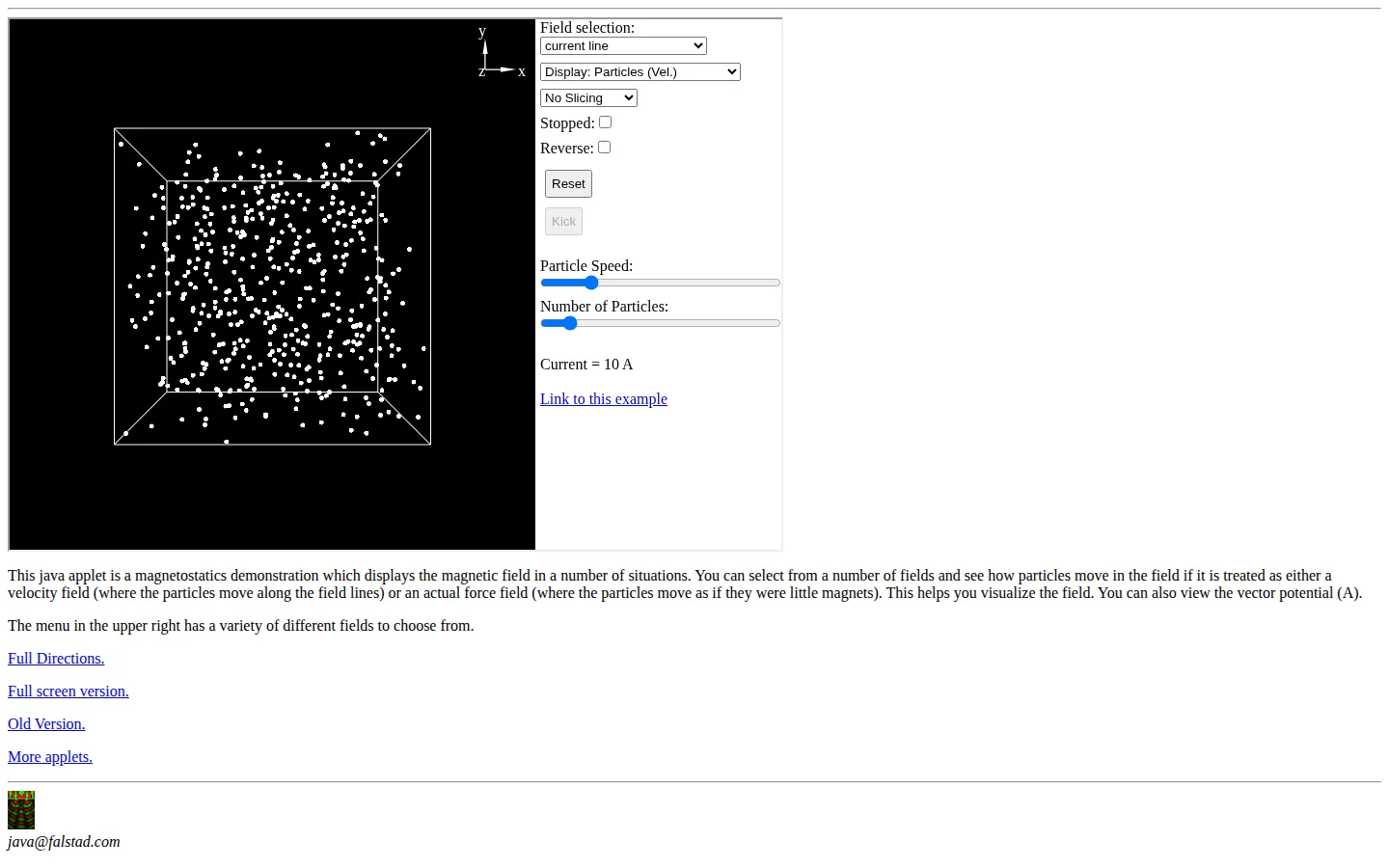
This compact simulation gives magnetostatics a visible shape. Choose a current or magnet arrangement, swap among particles, vectors, field lines, and vector potential, then change the view or density until the geometry clicks.
What is 3-D Magnetostatic Field Simulation?
A straight current is only the opening move. The documented menu ranges through paired currents, loops, solenoids, a toroid, a horseshoe electromagnet, a magnetic sphere, and even a deliberately doomed attempt at a monopole. Display choices let the same setup read as moving particles, a vector grid, colored field lines, vector potential, or simulated magnetic viewing film. Current markup also exposes stop, reverse, reset, kick, strength, particle-count, and density controls, while the directions describe rotation, zoom, and planar slicing. It is less a polished lesson than a sturdy workbench: pick one source geometry, change one representation, and watch an invisible three-dimensional structure become debatable.
What you can do there
- Compare magnetic-field arrangements
- Switch among particles, vectors, field lines, and vector potential
- Adjust the 3-D view and field display
Why we picked it
Magnetic-field diagrams often flatten a spatial idea into a thicket of arrows. This tool earns its keep by letting one arrangement wear several visual costumes, so a solenoid or current loop can be compared as particles, vectors, and lines instead of memorized from a single sketch. Its classroom use at LSU and recommendation by Cambridge also show that the slightly old-school interface still has practical teaching value.
How to get the most from it
Start with the straight current and switch from particles to field vectors or field lines. Rotate the view, then compare a current loop, solenoid, and toroid without changing every slider at once. Use slicing when the full box becomes visual spaghetti, and open the directions when a field-specific control appears.
Good to know
The creator cautions that the default moving particles are a visualization device, not literal charges traveling along magnetic field lines. The experience includes motion, and its runtime controls, mobile behavior, audio, accessibility, storage, and performance were not executed in this review. It is best treated as a conceptual visualizer rather than an engineering-grade solver.
Who made it, and when?
Paul Falstad is the credited creator or organization.
Creator’s official page Open 3-D Magnetostatic Field SimulationMore like this
Neal.fun

A cabinet of interactive ideas that makes learning feel suspiciously like play.
Quick, Draw!

Doodle against the clock while a neural network tries to guess your subject.
Sandspiel

Paint with sand, water, fire, plants, oil, and other tiny materials that react to one another.
WebGL Fluid Simulation

Push luminous liquid color around the screen and watch digital turbulence behave beautifully.