
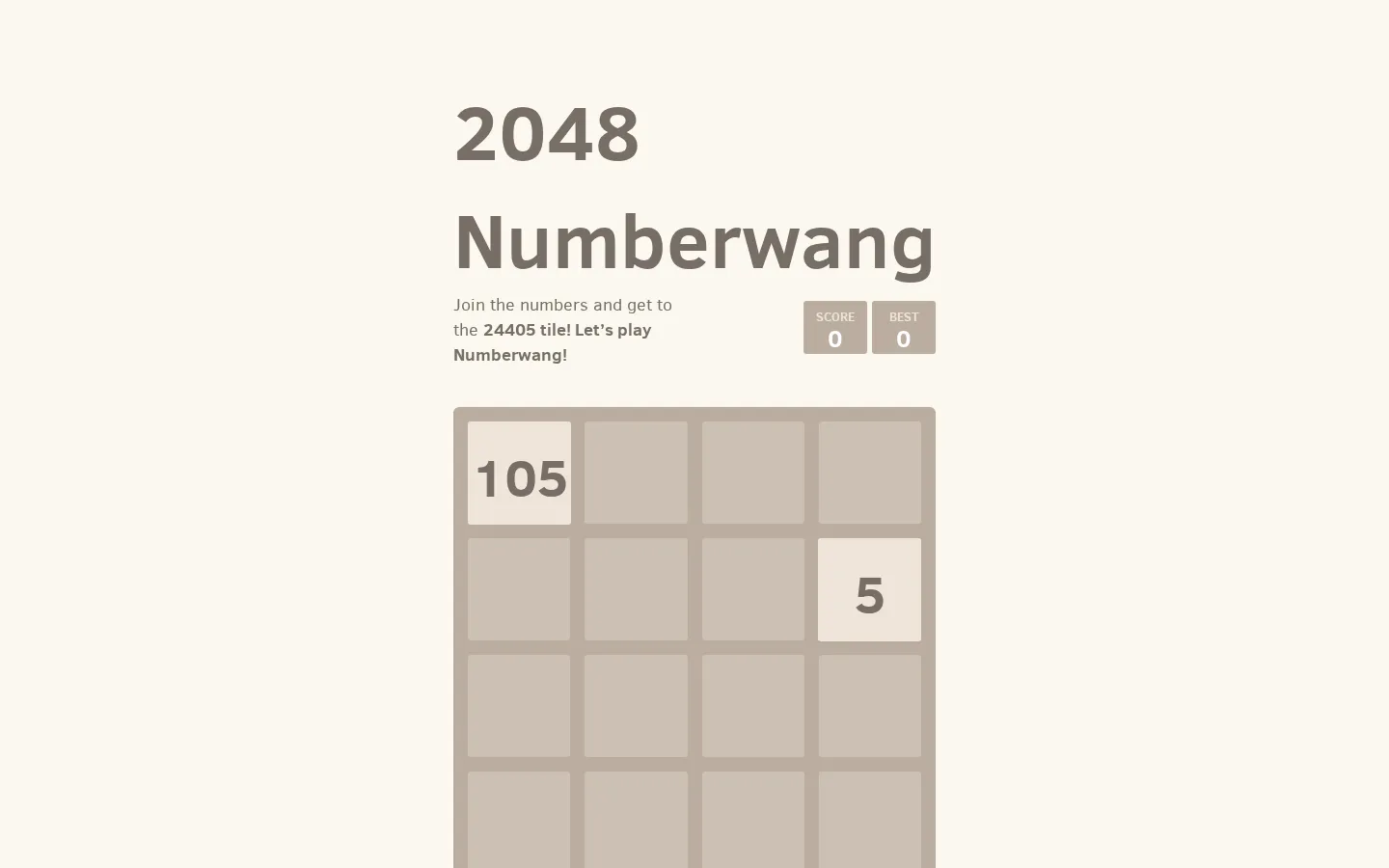
2048 Numberwang keeps the sliding-tile skeleton of 2048 and replaces mathematical dignity with changing labels, capricious merges, comedy announcements, and a board that may eventually rotate. The joke is nonsense; the puzzle underneath still rewards spatial discipline.
What is 2048 Numberwang?
The opening pitch looks comfortingly familiar: move tiles with the arrow keys and aim for 2048. Then the digits begin behaving like contestants on a quiz show whose rulebook was misplaced on purpose. The project code can redraw a tile's visible value, occasionally permit a wrong-looking merge, occasionally deny a proper one, and punctuate progress with a triumphant Numberwang. Beneath that misdirection, tile colors preserve the real hierarchy. Keyboard mappings cover arrows, WASD, and HJKL, while the source also includes touch swipes. At higher scores, the gag escalates with an external image request and a chance for the board itself to rotate. It is recognizably 2048, but with the arithmetic wearing a novelty mustache.
What you can do there
- Slide and merge tiles while their displayed numbers misbehave
- Chase the underlying 2048 progression by reading tile colors
Why we picked it
The parody does more than paste a television reference onto a familiar grid. It sabotages the information players normally trust while leaving enough structure for an actual strategy, creating a rare joke game whose punch line can sustain more than one move.
How to get the most from it
Watch the tile colors more closely than the printed numbers, keep your strongest color gathered near one corner, and protect empty space as you would in ordinary 2048. Use arrow keys, WASD, HJKL, or a swipe; when the board starts talking nonsense, assume that part is working perfectly.
Good to know
The changing labels make color recognition unusually important. Project code can request a random Giphy image after 1,500 points and can rotate the board after 3,100, so late play may involve third-party loading and motion. Current audio, browser compatibility, storage, and accessibility behavior remain unconfirmed.
Who made it, and when?
Lou Huang is the credited creator or organization.
Creator’s official page Open 2048 NumberwangMore like this
The Library of Babel

Search an imaginary library that contains every possible page of a fixed length—including this sentence somewhere.
FutureMe

Write an email to yourself and choose a date far enough away to make it meaningful.
Wowfold

A paper-plane hangar stocked with darts, gliders, and expert oddballs
Arcane Intern

A magical publishing internship where coffee runs come with sigils.