
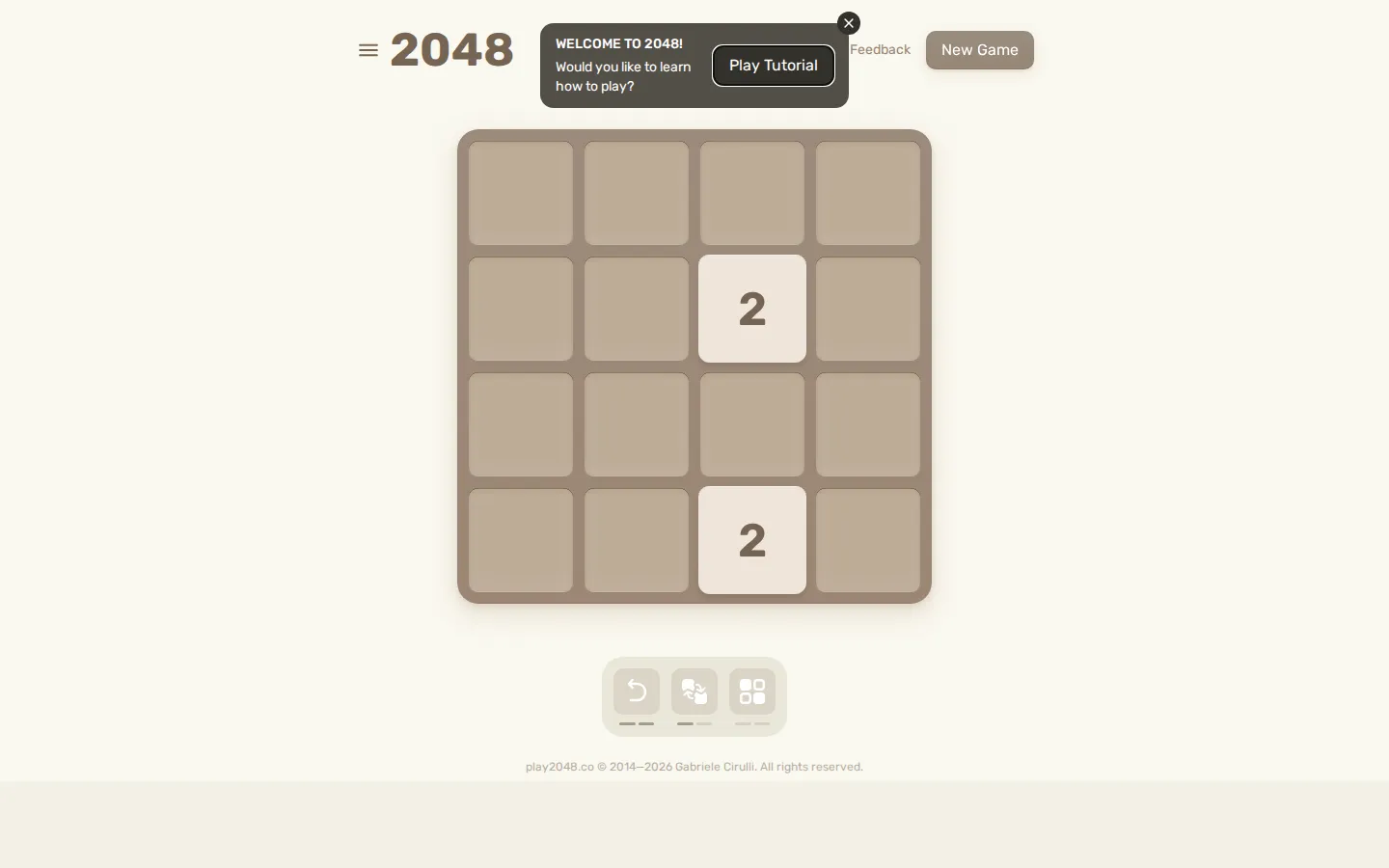
The original 2048 turns a 4-by-4 board into a compact arithmetic squeeze: slide every tile at once, merge matching numbers, and keep enough breathing room to build the namesake 2048 tile.
What is 2048?
A move sends the whole board in one direction. Equal neighbors collapse into a doubled tile, a fresh 2 or 4 arrives, and the available space shrinks a little more. That is the entire machine, and it is wonderfully merciless. The classic page keeps the furniture sparse: current score, best score, a New Game control, and the board. Reaching 2048 is the stated target, but the game can continue while legal moves remain. The page also openly identifies this as Gabriele Cirulli's original version and credits the earlier games that shaped it.
What you can do there
- Slide the numbered tiles with the arrow keys
- Merge equal tiles to build toward 2048
- Track the current and best scores
Why we picked it
Its charm is ruthless economy. One input can rescue a row, ruin a carefully stacked corner, and create the next problem simultaneously. More than a decade after its viral arrival, the original still shows how a plain browser puzzle can be instantly legible without becoming easy.
How to get the most from it
Use the arrow keys to slide every tile together; equal values merge when they meet. Keep your largest tile anchored near one corner, build smaller powers toward it, and avoid filling the board with isolated numbers. New Game provides the clean slate when the grid snarls beyond repair.
Good to know
The browser game is free and the page presents no account gate. Its privacy policy says game state is kept in browser local storage and discloses Google Analytics, Google AdSense, social-media features, and donation controls. Mobile app links are present, but their current availability and parity were not verified.
Who made it, and when?
Gabriele Cirulli is the credited creator or organization. The earliest supported launch date we found is March 9, 2014.
Creator’s official page Open 2048More like this
The Library of Babel

Search an imaginary library that contains every possible page of a fixed length—including this sentence somewhere.
FutureMe

Write an email to yourself and choose a date far enough away to make it meaningful.
Wowfold

A paper-plane hangar stocked with darts, gliders, and expert oddballs
Arcane Intern

A magical publishing internship where coffee runs come with sigils.